“Just As I Am/Tal Como Soy”

I can still remember the sound of my grandmother’s aged, beautiful, magical, and throaty voice singing the stanzas of the hymn “Just As I Am” as she washed dishes and looked out the window of her Wisconsin home. I was right at her side rinsing and drying, but as her gaze alternated between the items she scrubbed in the hot sudsy water and the trees outside, she was somewhere else entirely.

Perhaps this is why this hymn remains one of my favorites. It’s also one of the few remnants of my childhood piano lessons that I still play a crude version of on the piano. I’m no longer the small, innocent child standing at my beloved grandmother’s side, but a middle-aged adult who is much more familiar with all the highs and lows, success and failures that this roller-coaster of life brings us. The song now resonates with me for more reasons than nostalgic memory.

Written by Charlotte Elliott in 1835 and composed by William Bradbury, “Just As I Am” gained new popularity when Billy Graham used it consistently as the invitation hymn in his crusades. How appropriate, for it perfectly describes what it means to to see ourselves as sinners in need of grace, desperate for the pardon of a Holy God. We are humbled that God not only grants it, but sacrifices His beloved son to death on a cross so that we might receive it. 

This past summer, I had the words “Tal Como Soy”, the Spanish translation of “Just As I Am” tattooed on my arm to remind me of God’s grace and mercy, but also of His unconditional acceptance of me as His daughter, regardless of my shortcomings, mistakes, and circumstances.

In the past few years, I have known what it is to be rejected by close family and friends, simply for placing some much-needed boundaries in my life. This injured me at the deepest levels and has been enough to make me completely question my identity and perception of reality. Although I acted out of my personal conviction and understanding of God’s leading, as well as the results of everything learned in several years of therapy, these things weren’t enough to protect me from distorted versions of what happened or to help me escape harsh judgement. I attempted to take responsibility for my roles in these situations and to apologize, but those too seem to have disappeared into thin air. I’ve heard that boundaries can be described as the distance between which I can love both myself and another person well. Somehow, those I’ve been in conflict with missed seeing the love and health in the situation.

And so, the tattoo–to remind me daily that however I got here, I’m loved and accepted by my Savior just as I am.

Out of all the lullabies, songs and hymns that I have sung to my daughter at bedtime, “Just As I Am” has been one of her favorite requests over the past year. What a gift from God that I am so compelled to dwell, almost nightly, on the words. One of my favorite verses begins, “Just as I am though tossed about, with many a conflict, many a doubt.” How true, and yet these lead me through the journey of acceptance. I must learn to accept myself and my circumstances, and above all, accept how God sees me and the ways He is working.

Songwriter, singer, and worship pastor Jesús Adrian Romero has a beautiful song called “Tal Como Soy” (“Just As I Am”). In it he sings, “Just as I am, Lord. I have nothing to give but my heart” (My translation). How true. And so Lord, here is my battered, bruised, and misshapen heart. I’m all yours–do with me what you will.

HOPE–A Thorny Bloom

My yard is blessed by an overabundance of thistles–probably my least-favorite plant. With all the rain and wind we received in the late spring in our region this year, a few thistles multiplied to literally hundreds seemingly overnight. Thorny and prickly and nearly impossible to pull out without the right tools, gloves, and technique, they still seem to defy me and grow back the next week to impede the paths around our home and poke my toddler as she explores the yard. 

For all of these reasons and more, I was sure for the longest time that the thistle is a weed, and not just any old weed, but the meanest and most noxious weed of them all.  After noticing lovely blooms on the taller thistles around the area, however, I looked it up and was surprised to learn that it is a highly valued and beneficial flowering plant whose prickles simply help protect it from being eaten by herbivores. Not only that, but according to Wikipedia, “Biennial thistles are particularly noteworthy for their high wildlife value, producing such things as copious floral resources for pollinators, nourishing seeds for birds like the goldfinch, foliage for butterfly larvae, and down for the lining of birds’ nests.”

It made me wonder if the thorny plants in my life have benefits too, despite the mild suffering that comes from being pricked by their thorns. I’m reminded of Romans 5:3-5: “And not only this, but we also exult in our tribulations, knowing that tribulation brings about perseverance; and perseverance, proven character; and proven character, hope; and hope does not disappoint, because the love of God has been poured out within our hearts through the Holy Spirit who was given to us.”

This passage mystified me when I stumbled across it as a young adult digging deep into Scripture, for I was already naively hopeful and had suffered very little. I thought it strange that the Apostle Paul listed hope as the end result instead of the starting place.

Now, as a more seasoned believer who has had the wind taken out of her sails a few times, I understand. The “hope” I experienced as a young woman was really more like youthful optimism that cracked several times under pressure until it eventually shattered, revealed for the ingenuine thing that it was. It is as the Apostle Peter said in I Peter 1:6-7, “In this you greatly rejoice, even though now for a little while, if necessary, you have been distressed by various trials, so that the proof of your faith, being more precious than gold which perishes though tested by fire, may be found to result in praise, glory, and honor at the revelation of Jesus Christ.”

In times of suffering, there are times when it has been difficult for me to face it with character or to persevere in it and continue to put one foot in front of another. But Paul was right–the most difficult thing by far is to hope. Peter tells us to count it all joy that we are able to share in the suffering of Christ. Easier said than done, certainly. But what joy it is that the end result of it all is that blessed and elusive thing–genuine hope. Even the thorny thistle has the most lovely, vibrant, purple bloom. As Emily Dickinson said, “Hope is the thing with feathers that perches in the soul – and sings the tunes without the words – and never stops at all.”

“To Soar on Shifting Sand”

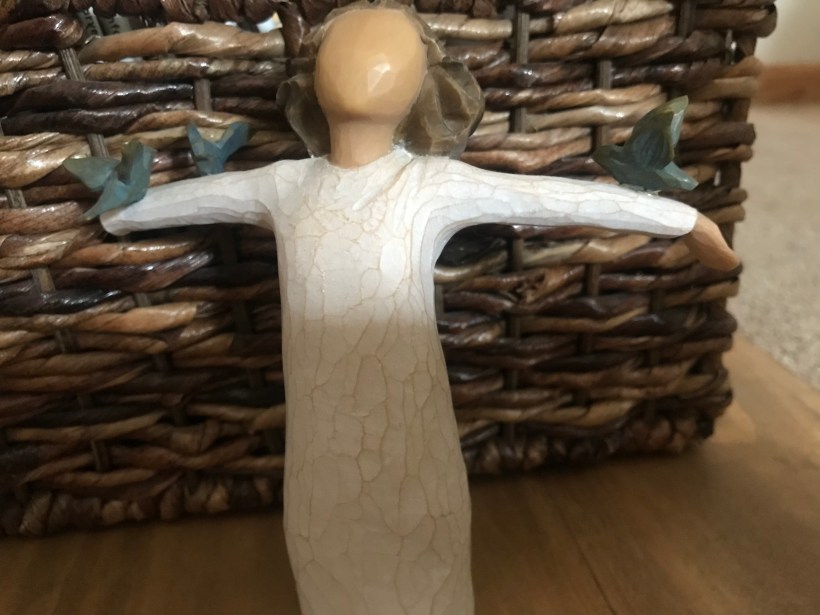
I’m a big fan of the WILLOW TREE figurines by Susan Lordi. Though they’re produced en masse, the originals are simple wood sculptures of people or angels that capture much of the range of human emotion. My favorite is called “SOAR” and features a woman with her joyful face angled towards the heavens, her arms stretched out wide, birds resting upon them.

I bought this figurine a few years ago in a season when I yearned to experience such freedom and needed the daily visual reminder that it was possible to soar. Over the last year, as my bird-loving toddler grows, “SOAR” has unfortunately taken quite a beating. I feel sad when I look at SOAR now, scratched and bruised, missing a hand and one bird, other birds replaced by glue. It feels like I’m in a similar condition. It’s easy to imagine I’m broken beyond repair, grounded for life, or unworthy of public viewing. And yet, I also note that despite how SOAR has been beaten and bruised, her arms are still raised, her face ever victorious and turned towards the sun.

In her book RISING STRONG, author Brené Brown discusses the concept that our culture is one that can value failure IF it leads to victory, but that we also easily gloss over the feelings of defeat, frustration, angst, loneliness, and struggle that so often accompany failure. We often forget that this is a place many of us stay in for a season or seasons, but that it is possible to rise up strong from it. I’m trying to have faith that I can do so too.

Early on in my adult life, I thought of myself as a person of strong faith. Although it was clear I didn’t have the mustard seed size required to move mountains (Matthew 17:20), it felt possible to eventually grow to that level. All it has taken, however, is a series of many trials over the years to knock the wind out of me. I know now that my faith is either non-existent or infinitesimally small. Like the SOAR and Moses, my arms have grown weak and weary and I have often needed others to hold them up. The friends who have done so are a big part of why I’m still holding on in the times when I can’t discern God’s hand or purpose.

If faith…is like shifting sand, changed by every wave… as the band Caedmon’s Call sings, perhaps the waves that continue to crash in can continue to shape it and make it something new, something pure and refined, something that isn’t mine at all. As Hebrews 12 says, God is “…the author and perfector of my faith.” Will He ultimately make it full and complete? The apostle Peter also tells us, “But this happened so that your faith, of greater worth than gold, may be found perfect and complete” (I Peter 1:7).

The final word on this subject for me, however, was written by the prophet Isaiah: 

“Why do you say, O Jacob, and complain, O Israel, “My way is hidden from the Lord, my cause is disregarded by my God”? Do you not know? Have you not heard? The Lord is the everlasting God, the creator of the ends of the earth. He will not grow tired or weary, and his understanding no one can fathom. He gives strength to the weary and increases the power of the weak. Even youths grow tired and weary and young men stumble and fall, but those who hope in the Lord will renew their strength. They will soar on wings like eagles, they will run and not grow weary.” Isaiah 40: 27-31

The Table—

“It was the best of times, it was the worst of times,” wrote Charles Dickens in A TALE OF TWO CITIES. A long while back, when I attended a debriefing conference after a year of missions in the Dominican Republic, the instructor used this phrase to describe the mission experience. Its profoundness struck and resonated with me as never before. 

Despite this, and despite the fact that I have chosen drifting between light and darkness as the theme of the novel I’ll finish one day, until recently, I somehow missed that it is one of MY life themes. I realized it when a beloved former student gifted me with a children’s book for my baby shower. Inside the cover, she wrote a note stating that the book reminded her of me because of the many conversations we had shared about all the beauty, challenges, joy, and sorrow life simultaneously offers us in our journeys.

I’ve been thinking about all of this again recently as I enjoy the rapture of watching my baby girl grow. I should say that due to sleep deprivation, my battle with chronic pain, and the busyness of trying to find balance after returning to work, I work at being present enough to enjoy every moment.

As I search for balance and joy amidst the challenges, I’m reminded of a phrase from the favored Twenty-third Psalm. David wrote of our Shepherd, “He prepares a table before me in the presence of my enemies.” IN the presence of my enemies, a table is prepared. I can picture that table. It’s a long banquet table set up on a sprawling porch, prepared with the choicest food and drink, decorated with flowers and fine linens, lit with candles. As the enemies of sleeplessness and pain and the frantic pace of American life look on, there I am, seated with my Shepherd at the close of day. My daughter and family and treasured friends surround us. We smile and laugh and enjoy one another as the sun sets. All the while, my enemies lurk and darkness descends.

Some days, as I practice gratitude in stillness, it’s relatively simple and easy to some to the table. Others, as as is typical of my dinnertime reality, I struggle to cease striving and sit still. A friend once described this type of experience to me as picking at the crumbs on the floor when I’ve been invited to a feast. Still other days, it feels as though I must fight my way through bramble and thorned brush just to find where the table IS. But the invitation is always there. 

My Lord says, Come, all you who are thirsty, come to the waters; and you who have no money, come, buy and eat! … Listen, listen to me, and eat what is good, and you will delight in the richest of fare” (Isaiah 55:1a;2b). As counterintuitive as it may seem, the beautiful table prepared is often an altar. I reach it best by kneeling, laying down my best efforts, perfectionism, and striving to do it all on my own—laying down selfish ambition and my ideals of what the table should look like, who I’ll be seated with, what will be served, and how long the meal should last. Above all, I must accept that my task is to enjoy THIS meal without worrying about the next, without being able to control that my enemies haven’t left me in peace. I must claim the peace and respite offered anyway. 

In her stunning book, AN ALTAR IN THIS WORLD: A GEOGRAPHY OF FAITH, author Barbara Brown Taylor invites, “Wherever you are, you live in the world, which is just waiting for you to notice the holiness in it. So welcome to your own priesthood, practiced at the altar of your own life. The good news is that you have everything you need to begin.”

“In Over My Head…”

In the old Sandra Bullock movie WHILE YOU WERE SLEEPING, the protagonist Lucy begins her narration by stating that her dad had told her as a child that life doesn’t always turn out the way you think it will. She wishes she had realized at the time he was referring to her life. Isn’t that the truth? We all hear similar counsel when we’re young, yet somehow believe our lives will be the exception to the rule. This reminds me of what an old gypsy proverb tells us, “We are ALL wanderers on this earth. Our hearts are full of laughter and our souls are deep with dreams.”

When life takes unpredictable turns or we choose the road less traveled and find that our path has led us in unexpected, even painful directions, disillusionment, even despair, can follow. What can we do with these overwhelming emotions except to look outside of ourselves for answers and peace? 

The only comfort I have found is in God. Though He didn’t promise an easy or predictable path, He did promise an abundant life full of His constant companionship and the strength He provides. Though my emotions and circumstances are constantly in flux, He never changes or wavers. There have been many times it’s been difficult to trust His hand, but He keeps drawing me in, assuring me of His heart and His tender care. Jenn Johnson of Bethel Music sings a song called “In Over My Head (Crash Over Me)” describing a similar journey of faith:

“And you crash over me, and

I’ve lost control but I’m free.

I’m going over, I’m in over my head.” 

These lyrics bring to my mind images and memories of swimming in the Caribbean ocean at high tide. As I head towards the surf and the tide crashes in, I’ll be lost and swept away if I try to fight. The more I’m willing to go with the tide and dive into its depths, however, surrendering to something stronger than myself, the better chance I have of getting to the other side. And on the other side, a view like none other awaits…a multi-colored horizon, a clean slate, a new beginning.

In “I Could Sing of Your Love Forever,” the band Delirious? sings,

“Over the mountains and the sea,

Your river runs with love for me,

And I will open up my heart and let the Healer set me free.

I could sing of your love forever….”

The sea is His love. Up to now, I’ve done little more than dip my toes in its water or wade in ankle deep. Today, I wade in and surrender. I release my expectations of what life is or will be and cling to His strong arms. May His goodness lead me in over my head and to the other side.

“A World Made, Yet Being Made” (John Muir)…

Snow falls gently again today after a weekend that brought a foot of snow. I look out the windows past my Christmas twinkle lights and the silver star that tops the tree, seeing and seeking a world made new. What a wonderful God we have–a God who brings beauty from ashes and makes all things new. I think of the many situations in my life that have seemed hopeless, yet through it all, God made a way.

John Muir said that we live in a world made, yet being made. Our awesome God is Creator and Sustainer of the earth. Yet in His great wisdom and affection for us, He has allowed us to play a role.Paradoxically, we all carry both beauty and brokenness within us. We live in a fallen world, yet we bear the image of a perfect God. Endless choices of what we will reflect are before us. In God’s Kingdom, we can choose to allow Him to redeem us, our surroundings, and our circumstances. Ralph Waldo Emerson said, “Though we travel the world to find the beautiful, we must carry it within us, or we find it not.”

An encounter with creation is always an encounter with its Creator. In God’s mysterious glory, He meets us there and allows us to come to His feet in whatever condition we are in. He has made us, yet we are being made. Whatever our journey, He is our Emmanuel, God present with us. And as the apostle Paul declared in Romans 8, “If God is for us, who can be against us?” 

In The Pilgrim at Tinker Creek, author Annie Dillard sought to observe and experience the marvels and mysteries of nature. She wrote, “I am prying into secrets again and taking my chances. I might see anything happen. I might see nothing but light on the water. I walk home exhilarated and becalmed, but always changed, alive. ‘It scatters and gathers, Heraclitus said, ‘It comes and goes.’ And I want to be in the way of its passage and cooled by its invisible breath.”

We may feel we have nothing of significance to offer the world, but God says differently by choosing to create and sustain our lives. Nelson Mandela used the following quote from author Marianne Williamson in his inauguration speech, 

“It is our light, not our darkness, that most frightens us. We ask ourselves, ‘Who am I to be brilliant, gorgeous, talented?’ Actually, who are you not to be? You are a child of God. Your playing small does not serve the world. There is nothing enlightened about shrinking so that other people won’t feel insecure around you. We are all meant to shine, as children do. We were born to make manifest the glory of God that is within us. It’s not just in some of us; it’s in everyone. And as we let our own light shine, we unconsciously give other people permission to do the same. As we are liberated from our own fear, our presence automatically liberates others.”

In this season that holds the darkest days of the year, yet one in which we celebrate the coming of the light of Christ the Messiah, may we each choose beauty…to let our own lights shine in the places we inhabit.

Call to Wonder…

As I drove home a couple of nights ago, a pink-orange sky bathed the rugged snow-capped mountains and low-hanging clouds in mystical light. The scene took my breath away. I thought of a card a dear friend once gave me for my birthday that pictured a little boy, mouth agape, gazing out the window at a newborn bird. The caption said, “Never lose your sense of wonder.” What a privilege to marvel again and again at God’s creation and this wonderful wild land where we live. As John Muir said, “Everybody needs beauty as well as bread, places to play in and pray in, where nature may heal and give strength to body and soul…. All that sun shines on is beautiful, so long as it is wild.”

As my husband and I await our first baby and stand in awe at this miracle of life developing each week, I am awakened once again to this Christmas season of wonder. I marvel at our creative Creator and the artistry with which he put together the world and each miraculous, unique life to grace it. Though this past year has been one to remember for all of us–a friend told me she’s heard 2020 will be the new swear word–I’m astonished at all the ways, big and small, our great God has provided for us within the storms.

In her many books and blogs, author Ann Voskamp invites us to offer a song of gratitude each day for every grace we are given. In Unwrapping the Greatest Gift she states, “You were formed to have front-row seats to waves hugging the shore, to trees touching the sky, to stars falling across the night–the whole of the universe falling in love with God…. You could unwrap the wow today just by going to the window. By going to the front door, to the park, to the backyard, or to the top of the highest hill you can find–standing there and staring and being wowed by the shape of the clouds or the color of the sky or the size of the sun when you hold up your hands.”

Edith Wharton, first woman to win the Pulitzer Prize for literature, has a quote I adore about how this kind of spirit can even keep you young. She said, “There’s no such thing as old age; there is only sorrow. In spite of illness, in spite even of the archenemy sorrow, one can remain alive long past the usual date of disintegration if one is unafraid of change, insatiable in intellectual curiosity, interested in big things, and happy in small ways.”

As we do the work of remaining alive and curious and grateful, may we be assured with the knowledge that regardless of what storms may come, we will never be alone on our journeys. As Lamentations 3 and the great hymn say, “Morning by morning new mercies I see. All I have needed Thy hand has provided, Great is Thy faithfulness, Lord unto me.”

“Just As I Am…”


Mistakes and failure seem to be a part of venturing bravely and wholeheartedly into this great big world, or just staying at home. I can’t say I’m thrilled about it. Over and over again, I come to the feet of God, the plea of Charlotte Elliott’s old hymn on my lips:


“Just as I am, without one plea,

But that Thy blood was shed for me.

And that Thou bidst me come to Thee.

O Lamb of God, I come. I come.”


As many times as I think I’ve accepted the fact that I’m going to make a million mistakes in this human adventure, the ugliness of failure hits me anew each time like running into a brick wall. Like author Anne Lamott, I must tape Hillel’s line on my wall, “I get up. I walk. I fall down. Meanwhile, I keep dancing.”


Nelson Mandela said, “The greatest glory in living lies not in never failing…but in rising every time we fall.” And I have this blessed hope. As I pick myself up and dust myself off, my loving Father greets me with His arms wide open. He looks at me tenderly, telling me without words that all is well, and all manner of things shall be well. He whispers that He has loved me with an everlasting love (Jeremiah 33:3) and I am completely right with Him through the blood of His Son (II Corinthians 5:21).


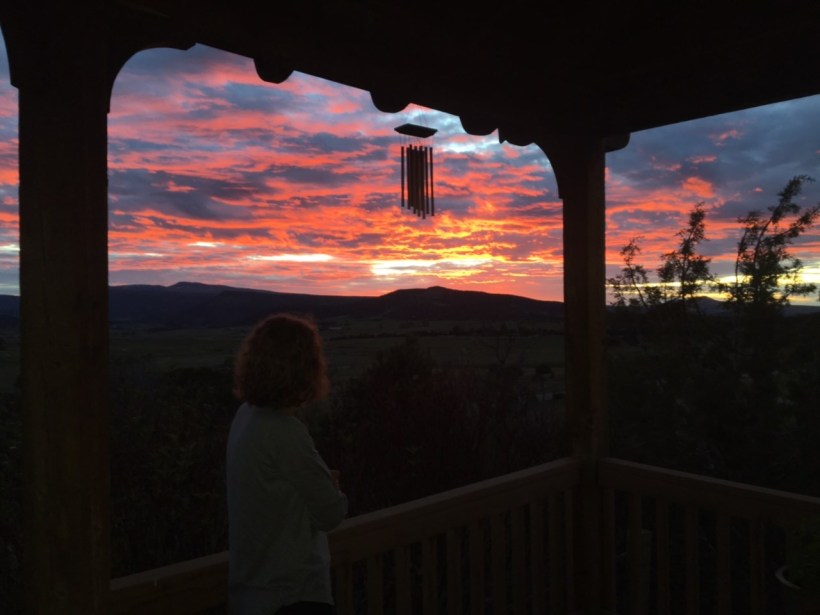
I walked yesterday, a few things troubling my spirit, the weather windy as a storm rolled in. As I rounded the corner to my house, a warm sunset greeted me. Pastel purples, pinks, and yellows stretched thin across the western sky. Just then, a small wren landed on top of my wind chimes and sat there bouncing joyfully in the wind. As he began his song, accompanied by both the stormy breeze and the chimes, silhouetted by the mellow evening sky, part of a favorite song came to me: “I sing because I’m happy, and I sing because I’m free. His eye is on the sparrow, and I know He watches me.”


That night I read a portion of Bill Holm’s poem Ann Lamott quoted in her book BIRD BY BIRD called “August in Waterton, Alberta,” and it connected these musings on failure and songs in storm:


“Above me, wind does its best

To blow leaves off

The aspen tree a month too soon.

No use wind. All you succeed

In doing is making music, the noise

Of failure growing beautiful.”


Though perhaps my time for success in certain realms has not yet come, if it ever shall, and the wind may blow all the while, my roots grow deep and my colors turn bright and beautiful. “Meanwhile, I keep dancing” (Hillel).

“I’ll Follow the Sun…”

I’m loving the extra light within each day as summer approaches. Every morning I’m greeted by a stunning sunrise creeping over the jagged mountain peaks, stirring my soul and taking my breath away as it gradually lights and touches them with rainbow hues. But…I should say that’s true–the light stirs my soul and takes my breath away–only if I let it. I must take the moment to breathe deep, to be still, to take in all that goodness–a surprisingly difficult feat. That act of stillness is a gift of kindness I can show myself or share with others. Most days, I drive myself on to the next thing and the next thing without taking the time to stop and accept the series of similar gracious gifts I’m given, forgetting what Mary Oliver says, “Sometimes I need only stand wherever I am to be blessed.” 


I’m currently taking a wonderful course from Life is Good Playmakers called “Compassion is a Superpower.” It highlights the fact that human beings are all wired with compassion and empathy but that these are qualities that can be controlled. We can each either choose to repress them, as we often do out of busyness, or cultivate them. Yet the simple act of being PRESENT, opening our eyes to truly see those around us, can help us to show more empathy and grow the quality of compassion. Research has shown that different areas of our brain respond and grow as a result. Learning about this science takes me back to the importance of breathing to slow down each day, reminding myself that life is not an emergency. 


Another study I’m doing highlights verse six of the Twenty-Third Psalm: “Surely goodness and mercy will follow me all the days of my life, and I will dwell in the house of the LORD forever.” As author Jennifer Rothschild says, this promises us that “…goodness and mercy invade every scene of our stories” (emphasis mine). Jennifer also asks, since that is the condition we are being left in, do we also allow goodness and mercy to follow us when we leave a room or an interaction? I want to live slowly and intentionally enough that this is true. I also know that I can’t give what I don’t have. If I am to show empathy towards others, I must first allow enough space and grace in my life that I can practice self-compassion. An unknown author encourages us, “Validate humanity without highlighting brokenness.” What an important practice in both the way I treat myself and others.


I want to “Follow the Sun,” as Xavier Rudd sings:


“So follow, follow the sun…

The direction of the bird,

The direction of love.”


When I think of living in the light, I think of living in the full-fledged Presence of God. Elizabeth Barrett Browning wrote, “Earth’s crammed with heaven, and every common bush afire w/ God; but only he who sees takes off his shoes.” If that’s true, I aim to walk barefooted through this one great life we’ve been given. I hope I can stay with this thought from Max Lucado: “Next time a sunrise steals your breath or a meadow of flowers leaves you speechless, STOP, remain that way. Say nothing and listen as heaven whispers, “Do you like it? I did it just for you?”

“Always We Begin Again…”

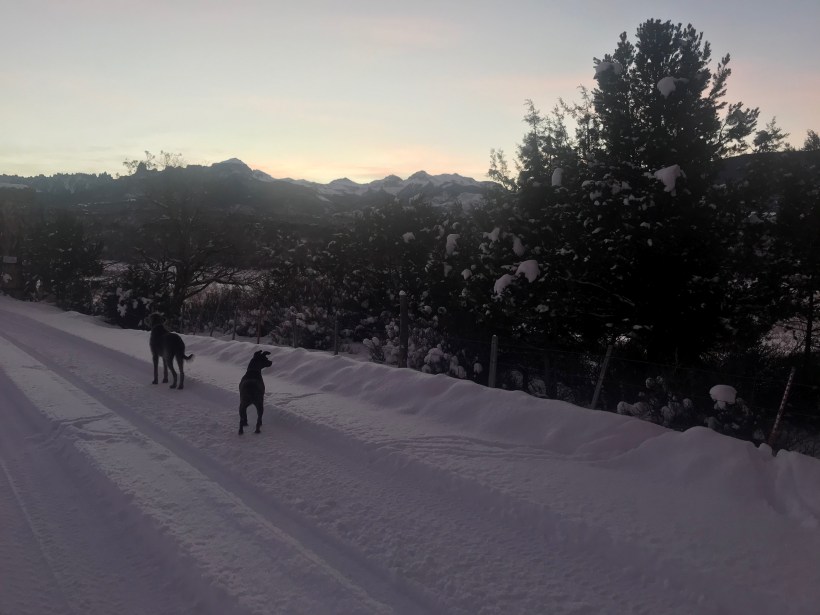
As I walked my dogs the other morning, I looked out onto a world made new. The crisp azure sky highlighted jagged mountain peaks covered in a dazzling fresh coat of snow. Cat Stevens’ song rang out in my mind, “Morning has broken, like the first morning. Blackbird has spoken like the first bird. Praise for the singing, praise for the morning….” Creation is continually sustained and remade, just as we are.


The new year and decade remind me that no matter where we’re at, whatever regrets we have or roads we may wish we had taken in the past, whatever has us feeling trapped or stuck, it’s always possible to find redemption for the areas in which we fall short and start over. As the great poet Rainer Maria Rilke prompted, “Let us believe in a long year that is given to us new, untouched, full of things that have never been.”


Leeana Tankersley writes about the prayer of St. Benedict used to call the saints of old to the holiness of repetition, “Always we begin again.” As an intention for each new year, day, or moment, it reminds us that all of life is about the openness for continual renewal. As Tankersley writes, “…that’s what so much of life is–learning how, and learning how again, over and over.”


Colombia has one of the oldest standing guerilla armies in the world and a long-standing internal conflict that has killed hundreds of thousands, affecting over nine million. Executive Jose Miguel Sokoloff and a group of peacemakers led their native country in transformation over several years during the holiday season.* Initially, they covered a path from the jungle where the guerillas hid with Christmas lights and left a message stating, “If Christmas can come to the jungle, you can come home. Demobilize. At Christmas, everything is possible.” The message worked and soldiers began to lay down their arms. The next year, Sokoloff’s group put bouncy balls that lit up into the rivers with personal messages inside from families who had soldiers fighting. Several soldiers a day returned home. Eventually, as many as 17,000 laid down their weapons. 
If this kind of societal transformation is possible, what is conceivable within our own individual stories? Will we allow the things that break our hearts to also crush our spirits? Will paths that fizzle out become dead ends or opportunities to forge a new road? Will each new day be a reminder of the time we’ve lost or of all that awaits? Emily Dickins exhorted, “The soul should always stand ajar, ready to welcome the ecstatic experience…DWELL IN POSSIBILITY.” If we are open-hearted and open-minded, willing to embrace a life that will consistently surprise us and a Creator that will continually transform us, the possibilities are endless. We can always begin again.

*(1) Lisa Shipley, “Christmas after Christmas: How a Colombian ad exec helped demobilize guerrillas by advertising peace,” The Bogota Post, December 3, 2017.