Justice and Mercy: Only What is Required

-From very early in its history, the United States of America, despite being a nation of immigrants, has desired to keep more immigrants from breaching its shores. The populations of those deemed less tolerable have changed over time, from Irish to Italians, Jewish to Blacks, Asians to Hispanics–we never seem to run out of groups to place in a lower social stratosphere. White American males, especially those who are wealthy, and most of whom define themselves as Christians, have long controlled the definition.

But as Christians, we are called to so much more. Very early in the Israelites’ walk with God, He instructed them: “When a foreigner resides among you in your land, do not mistreat them. The foreigner residing among you must be treated as your native-born. Love them as yourself, for you were foreigners in Egypt: (Leviticus 19:33-34, emphasis mine). 

When the Israelites sewed and gathered their crops, they were instructed to leave some of the harvest behind so that strangers among them could come and gather food. And in Malachi 3:5, the Lord says that there will be consequences if the foreigner is not treated fairly: “So, I will come to put you on trial. I will be quick to testify…against those who defraud laborers of their wages, who oppress the widows and the fatherless, and deprive the foreigners among you of justice.”

The poet Mary Oliver wrote what echoes my own heart here: “I tell you this to break your heart, by which I mean only that it break open and never close again to the rest of the world.”

Though many would deny it, these unprecedented times in which we Americans live in the year 2026 are strikingly similar to those of the early days of Nazi Germany. Congress has approved family separation, detention, and mass deportation policies. A small group of people holds tremendous power and an extremely loyal following. A new brutal domestic law force, composed of masked agents with high salaries and as little as three weeks training, has been given more jurisdiction and greater immunity than our military. They’ve been provided with the same weapons used to fight terrorists in Afghanistan and sent into our communities on the pretense of defending our borders. One group of people, who have been deemed inferior and often stripped of their humanity, are separated from their families and sent to detention centers conveniently hidden from the public eye. 

And now innocent American citizens who stand up for them are being mistreated, denied basic constitutional rights, and even murdered in plain sight while the administration lies to us. Because of the President’s September 25, 2025 edict that anyone who opposes his agenda is engaged in domestic terrorism, we are supposed to believe that those who were brutally murdered were actually involved in such acts. 

This is to say nothing of the countless others detained and imprisoned, many American citizens among them, brutally taken from their homes and cars without ever being asked for their IDs, and imprisoned. One American citizen and survivor of the Whipple Detention Center stated that as awful as the murders of Renee Good and Alex Pretti were, they could not compare to the horrors she experienced and witnessed inside the detention center. 

As Allison Burns La-Greca of St Mary’s Church in Stone Harbor, NJ  wrote:

“I am done pretending this is complicated. When an institution terrorizes communities, separates children from parents, disappears people into cages, and now sheds innocent blood, it forfeits any claim to moral legitimacy. ICE is not broken. It is functioning exactly as designed. It is an instrument of cruelty, and it is being wielded by an administration that has chosen fear over humanity, domination over dignity, and violence over justice.”

Political scientist and social justice activist Dr. Heather Cox Richardson affirms that we are now past the point where we can deny that we all have a role to play in standing up for justice. It is easy to stay quiet in our feelings of powerlessness, but we must remember that our own rights can quickly be lost. When imprisoned by the Nazis, Pastor Martin Neimoller stated: 

“First they came for the Communists

And I did not speak out

Because I was not a Communist

Then they came for the Socialists

And I did not speak out

Because I was not a Socialist

Then they came for the trade unionists

And I did not speak out

Because I was not a trade unionist

Then they came for the Jews

And I did not speak out

Because I was not a Jew

Then they came for me

And there was no one left

To speak out for me”

Once again, we are called to more than isolationism. The prophet Micah explains what God desires for us: “And what does the Lord require of you? To act justly and to love mercy and to walk humbly with your God” (Micah 6:8). Mercy is defined by the Oxford dictionary as “…compassion or forgiveness shown toward someone whom it is within one’s power to punish or harm.” Justice is “…just behavior or treatment; a concern for fairness, peace, and genuine respect for people”. 

I realize that I am probably preaching to the choir. So many of us feel powerless, but it is in banding together as communities that we find our power, just as the Twin Cities has done. Perhaps, as Mother Teresa suggests, it is also through small acts of love that we can do great things. It is easy, perhaps even right, to be angry, but as the great social justice leader and champion for nonviolent resistance Dr. Martin Luther King said, “Darkness cannot drive out darkness, only light can do that. Hate cannot drive out hate, only love cannot do that.” 

I am praying daily, “For all in positions of power; that they may have hearts of compassion and become advocates for the vulnerable and the oppressed” (author unknown). May they be brought to their knees and have changes of heart through Scrooge-like encounters where they see how their pasts have led them to the present, and how their present choices will lead to everlasting consequences unless they change their ways. 

What is required of us is very simple, and yet sometimes so far beyond our grasp–”…to act justly…to love mercy…to walk humbly with [our] God.” I believe in love, that ultimately, love will help us find a way out of these dark times. As Jesus said in Matthew 25:35-40:

“35 For I was hungry and you gave me something to eat, I was thirsty and you gave me something to drink, I was a stranger and you invited me in, 36 I needed clothes and you clothed me, I was sick and you looked after me, I was in prison and you came to visit me.’ 37 “Then the righteous will answer him, ‘Lord, when did we see you hungry and feed you, or thirsty and give you something to drink? 38 When did we see you a stranger and invite you in, or needing clothes and clothe you? 39 When did we see you sick or in prison and go to visit you?’ 40 “The King will reply, ‘Truly I tell you, whatever you did for one of the least of these brothers and sisters of mine, you did for me.’”

One day, we shall overcome. May love rescue each and every one of us.

“In the Bleak Midwinter”

 Christmas is a season of hope and celebration, of joy and connection. People of faith celebrate the peace brought by the coming of the Messiah and wonder in the miraculous time when God the Father and His Son, Jesus, endured a painful separation from one another so that Love could come down and meet each one of us. 

On the surface, all is celebration as we decorate our homes, attend gatherings, prepare and exchange gifts. But isn’t it also a time where many of us feel the darkness of winter, confront the unsatisfied longings of our hearts, face relational losses or conflicts within our families, and encounter the sin in our own hearts? 

Ultimately, we must turn to Jesus as the only one who can truly bring us light and peace, for Jesus first came into such a place, a people longing for relief from oppression, to a world that was dark and lifeless. The prophet Isaiah foretold that life would come from such a place: “A shoot will come out from the stump of Jesse; from his roots a Branch will bear fruit” (Isaiah 11:1). From something that appeared dead, God brought forth the greatest gift imaginable–the “Wonderful Counselor, Mighty God, Everlasting Father, Prince of Peace. Of the government and of peace there will be no end (Isaiah 9:6-7a)….”

The past several years have held quite a bit of darkness for me. Although there are certainly those who have suffered far more, if I look at my life’s trajectory and compare it to those of many others, it’s easy to question why mine has contained so much sorrow and why circumstances still remain so challenging. For a long time, I’ve been spinning my wheels–griving necessarily, but also stuck in that grief and lost in questioning why. A good friend has been working with me on releasing the questions, working towards radical acceptance, and rewriting my story. I still have a long way to go, but it is quite freeing to begin letting go of the old narratives and imagine what I want the new story to be–to work with what is in my control. And isn’t this just what Jesus came to do–to rewrite our stories?

As I do this work, I’m struck by all that God has been doing in the dark all along. One day, as my friend wrote for me, I’ll be able to say, “Her past is a garden she has weeded and watered. The pain is compost now, it feeds the roses.” Winter eventually gives way to spring. The plants that were dormant for a season come to life with newfound beauty. The unfathomable pain of the cross brought about the inconceivable promise of the resurrection. And God is renewing each of us every day.

As Episcopal Bishop Steven Charleston once wrote: 

“The truth of any sorrow is that it makes us new. We have no choice but to start again. To be born again. And because we are so new, so young, so fragile, we cannot do that alone. Therefore God, through mercy and love, sends a miracle to enter the darkness with us, to bring us the healing and the peace we need to replace the loss and the fear.

Where you are right now is a manger. It may be poor in the eyes of the world but it is holy ground. It is the place God has chosen…a starting place…a sacred place…. Right there, with you, underground, in the kiva, so safe, so warm, so full of light.”

In whatever condition we find ourselves, we must cling to the hope promised us in Psalm 138:8 (NASB): “The LORD will accomplish what concerns me; Your faithfulness, LORD, is everlasting; Do not abandon the works of Your hands.”  In the 1872 hymn “In the Bleak Midwinter”, Christina Rossetti wrote:

“Our God, Heaven cannot hold Him nor earth sustain

Heaven and earth shall flee away when He comes to reign

In the bleak midwinter, a stable place sufficed,

The LORD GOD ALMIGHTY, Jesus Christ.”

“Just As I Am/Tal Como Soy”

I can still remember the sound of my grandmother’s aged, beautiful, magical, and throaty voice singing the stanzas of the hymn “Just As I Am” as she washed dishes and looked out the window of her Wisconsin home. I was right at her side rinsing and drying, but as her gaze alternated between the items she scrubbed in the hot sudsy water and the trees outside, she was somewhere else entirely.

Perhaps this is why this hymn remains one of my favorites. It’s also one of the few remnants of my childhood piano lessons that I still play a crude version of on the piano. I’m no longer the small, innocent child standing at my beloved grandmother’s side, but a middle-aged adult who is much more familiar with all the highs and lows, success and failures that this roller-coaster of life brings us. The song now resonates with me for more reasons than nostalgic memory.

Written by Charlotte Elliott in 1835 and composed by William Bradbury, “Just As I Am” gained new popularity when Billy Graham used it consistently as the invitation hymn in his crusades. How appropriate, for it perfectly describes what it means to to see ourselves as sinners in need of grace, desperate for the pardon of a Holy God. We are humbled that God not only grants it, but sacrifices His beloved son to death on a cross so that we might receive it. 

This past summer, I had the words “Tal Como Soy”, the Spanish translation of “Just As I Am” tattooed on my arm to remind me of God’s grace and mercy, but also of His unconditional acceptance of me as His daughter, regardless of my shortcomings, mistakes, and circumstances.

In the past few years, I have known what it is to be rejected by close family and friends, simply for placing some much-needed boundaries in my life. This injured me at the deepest levels and has been enough to make me completely question my identity and perception of reality. Although I acted out of my personal conviction and understanding of God’s leading, as well as the results of everything learned in several years of therapy, these things weren’t enough to protect me from distorted versions of what happened or to help me escape harsh judgement. I attempted to take responsibility for my roles in these situations and to apologize, but those too seem to have disappeared into thin air. I’ve heard that boundaries can be described as the distance between which I can love both myself and another person well. Somehow, those I’ve been in conflict with missed seeing the love and health in the situation.

And so, the tattoo–to remind me daily that however I got here, I’m loved and accepted by my Savior just as I am.

Out of all the lullabies, songs and hymns that I have sung to my daughter at bedtime, “Just As I Am” has been one of her favorite requests over the past year. What a gift from God that I am so compelled to dwell, almost nightly, on the words. One of my favorite verses begins, “Just as I am though tossed about, with many a conflict, many a doubt.” How true, and yet these lead me through the journey of acceptance. I must learn to accept myself and my circumstances, and above all, accept how God sees me and the ways He is working.

Songwriter, singer, and worship pastor Jesús Adrian Romero has a beautiful song called “Tal Como Soy” (“Just As I Am”). In it he sings, “Just as I am, Lord. I have nothing to give but my heart” (My translation). How true. And so Lord, here is my battered, bruised, and misshapen heart. I’m all yours–do with me what you will.

Leave Them Better…

Henry Van Dyke once said, “There is a loftier ambition than merely to stand high in the world. It is to stoop down & lift man up a little higher.” How easy it is to get caught up in the enticing busyness of everyday living. Though we may not set out to “stand high in the world,” in the end, the effort to “keep up” can be self-consuming. 

And yet, need is always in the world around us. If we take time to look into the faces around us, to truly see people, we find a world muddling through various desperate circumstances. Empathy, compassion, and generosity are there in many individually, but relatively speaking, they are still in short supply. Ian Maclaren once said, “Be kind, for everyone you meet is fighting a hard battle.” Though the struggle is different for each one of us and varies in different seasons of our lives, it is there for all of us nonetheless.

A colleague reminded me recently that although I’m a perfectionist, it’s okay to let go sometimes. In this crazy COVID world we’re all currently experiencing, to slow down and be present with kids is one of the best gifts we can give them. The same is true for adult needs as well.

In her book, WHEN THINGS FALL APART, Pema Chödrön suggests that one way to relieve our own suffering is to face it, recognizing it for what it is instead of running away from it and allowing it to rule us. In our willingness to face this pain, we can begin to focus on others in the world who might face the same difficulty and emotions. As we awaken to the suffering of others and wish for improvement and relief for all, we can begin to spread contagious compassion and empathy. 

Mother Teresa once said, “Let no one come to you without leaving him better.” What a great reminder, a wonderful intention to set. It’s another way of saying I must learn to keep judgement from my heart and  love my neighbor as myself. Today, I choose to open my eyes, remove them from myself, and focus on others. Albert Schweitzer said, “Until he extends his circle of compassion to include all living things, man will not himself find peace.” I will need to choose this attitude over and over again. Each time that I practice, it will become easier to leave others better after our encounters. I can be a small part of making peace on earth with my own two hands.

Perspective & Gratitude…

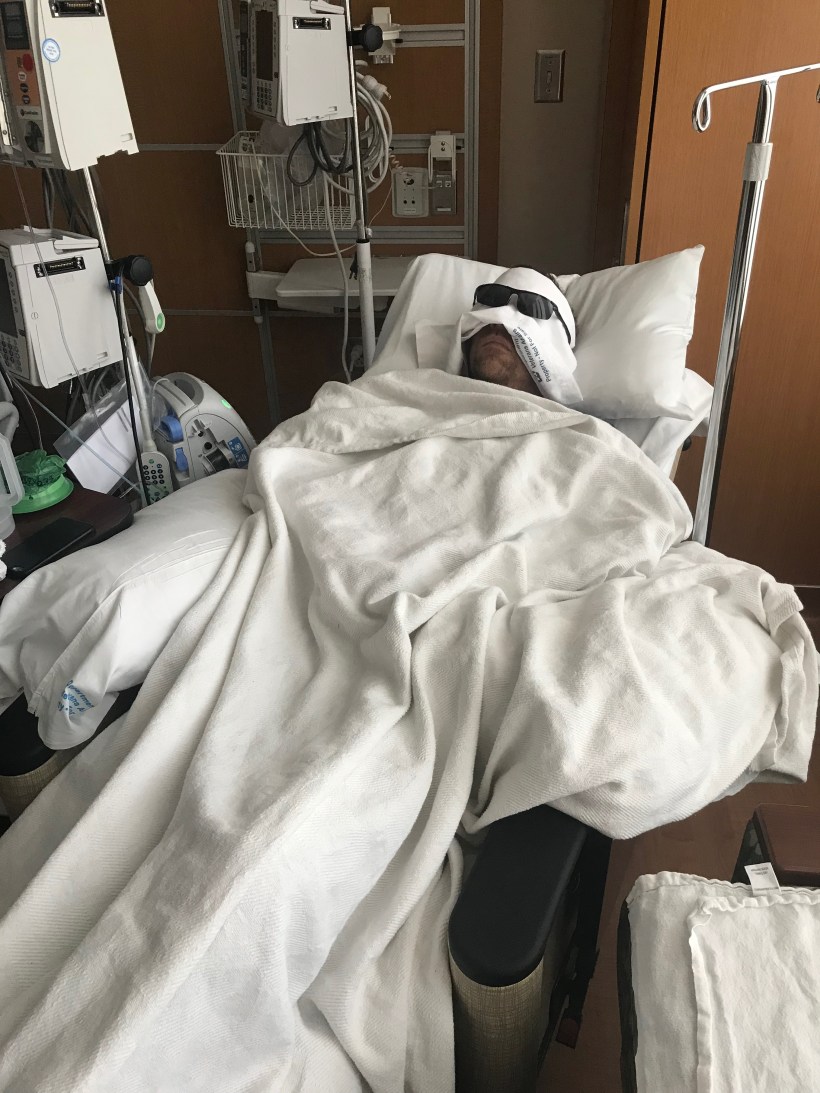
It’s amazing how an unexpected trip to the emergency room and stay in the hospital can provide a new perspective on things. After two intestinal surgeries to remediate the effects of his Crohn’s Disease, my husband is finally beginning to heal, and we are grateful.

One of the biggest things I’ve learned is that marriage worked–we truly are one. As my husband has bravely suffered countless procedures, pokings and proddings, two operations, the night of the drug-induced coma between them, the intense sleepless days in the ICU after, and the indignity of the ileostomy bag he’ll need for several more months, I have felt at least a small share of his pain in it all. Every time I have to leave him or be separated from him or watch them stick something else into him, I physically feel the pain of it and my heart breaks for him. Often it feels as though I’m leaving a part of myself behind. Despite the difficulty of all of this, we know that God is making us stronger and more united, increasing our love for one another day by day. Mikael is loved by all the nurses and providers here for his positive attitude and the way he thanks them for everything they do, even those that are painful or uncomfortable. I come to admire my Mikael more every day too.

Each one of those experiences that’s been hard or humbling or uncomfortable we’re doing our best to bless, knowing that when you bless something it loses its power to hurt you. So we bless the N/G tube in his nose that made him gag and prevented him from turning his head. I bless the nurses that see him naked and get irritated with my questions or requests (though overall, they’ve been wonderful!). We bless each thing as an instrument of God’s healing and growing work in our lives.

We’re learning to give thanks for each small miracle, and we’ve had a lot this week! We got to leave the ICU and get onto a regular ward floor, enabling Mikael to get some better rest. We’ve had good visits from family and friends and feel love and support from those who are far away. Mikael got his N/G tube out and can move his head freely! On other days he got his catheter out, an IV taken out of his left hand, and one out of his right hand. Yesterday, they took off his wound covering and the wound-vac pump that went with it. Then, the miracle of all miracles, I got the first hug I’d had in almost a week because he was free enough of tubes to make it possible!

Mikael’s making some physical strides of progress. He was able to walk all the way down the ward hallway and sit outside on the patio and I don’t think we’ve ever been so grateful to look out at the I-225 traffic on a cloudy day and feel the breeze :). Yesterday, Mikael got his first bite of real food in twelve days and began to weep it tasted so good. Today, he had his first shower in six days and it left him speechless. Both of us may sleep an hour or ninety minutes at a time here at night, but we’re just so thankful to get that much, and that we can be together, and that he’s okay.

We know that our Father is good and that we have never been out of His care. That’s definitely been proven to us by having so many beautiful loved ones in our lives! As well as we may know them, we’re learning again the words of Paul by heart, “Rejoice always; pray without ceasing. In everything, give thanks, for this is the will of God for you in Christ Jesus” (I Thessalonians 5:16-18). My favorite author Wendell Berry said it well too, “What we must do is this: ‘Love always, pray continually, in everything give thanks.’ I’m not all the way capable of it, but I know those are the right instructions.” These events that have interrupted the normal events of our life also serve as an invitation to draw even more near to God’s heart–gratitude is one of our paths and we have chosen to take it.

“O Cross that Liftest Up My Head” (George Matheson)…

The final stanza to George Matheson’s hymn “O Love That Will Not Let Me Go” makes clear the calling each follower of Christ is called to:


O Cross that liftest up my head

I do not ask to fly from thee

I lay in dust life’s glory dead

And from the ground there blossoms red

Life that shall ever be.


Our earthly lives can be full of blessing, and simultaneously, full of suffering, marked my wounds and scars we’ve received along the way. The apostle Peter speaks to this in I Peter 4:12: “My dear brothers, do not be surprised at the test you are suffering, as though something unusual was happening to you. Rather, rejoice that you are sharing in the suffering of Christ, so that you may be full of joy when His glory is revealed.”


We share in the suffering of Christ, who suffered all things for us, and we are promised joy as the end result. When Jesus returned to the disciples after the crucifixion and the apostle Thomas doubted his resurrected identity, Jesus told him to feel the wounds in his side and his hands. Jesus offered Thomas total transparency, knowing this apostle would one day be martyred for his efforts to share the gospel in modern day India.


As author Sheila Walsh states in her book It’s Okay Not to Be Okay: Moving Forward One Day At a Time:
“There is no image that displays the love of God more perfectly than the scars of Jesus. The scars tell God’s story. ‘That Sunday evening the disciples were meeting behind locked doors because they were afraid of the Jewish leaders. Suddenly, Jesus was standing there among them! ‘Peace be with you,’ he said. As he spoke, he showed them the wounds in his hands and his side. They were filled with joy when they saw the Lord!’ (John 20:19–20)

But before the joy, there was heartache and questions. Nothing made sense anymore.

We all know we’ll face challenges in life, but sometimes we’re hit by something that feels as if the enemy has won. That’s a frightening place to be. That must have been how the disciples felt that night.

But as the risen Christ held out His nail-pierced hands and wounded side to His friends, they were no longer marks of death, they were signs of victory: declaring that death was overcome by the blood of the Lamb. Christ wears those scars in heaven as glorious trophies of the battle He has won.

The only wound from this earth in eternity will be the scars of Christ (emphasis mine). If Christ has chosen to live eternally with His scars, why would we be ashamed to show ours?

I think that every time God the Father sees the pierced hands and feet of Christ, He sees you and me. The scars tell God’s love story.

The love of God invites us to bring our scars into the light. We don’t have to hide anymore. It really is okay not to be okay.

Our scars are proof that God heals.”