“No Hard Feelings” (Avett Brothers)…

I recently watched a documentary about Audrey Hepburn. It wasn’t the first I’ve seen about an amazing actress and humanitarian I’ve long admired for her beauty, grace, joy, and sweetness. The documentary featured an interview with her in her later years in which Audrey was asked how she maintained her positivity in the face of the loss and hardship she had experienced in life, particularly during her youth when she lived, and nearly starved,  in Nazi-occupied Holland during World War II. Audrey responded that she had always felt that life gives us a choice…we can choose to embrace it with all its complexity, or to reject it with all the consequences that will follow that attitude.

How true that is! Life is complex, ever offering a mix of loveliness and ugliness, joy and grief, happiness and hardship. Though our individual journeys vary widely, we all wade through our own circumstances in their seasons–no one rides for free. And yet, despite all that is out of our control, there is so much for which we can claim ownership. First and foremost among these are our attitudes and ways of engaging in the world.

Chuck Swindoll once said, “The longer I live, the more I realize the impact of attitude on life. Attitude, to me, is more important than facts. It is more important than the past, the education, the money, than circumstances, than failure, than successes, than what other people think or say or do. It is more important than appearance, giftedness or skill. It will make or break a company… a church… a home. The remarkable thing is we have a choice everyday regarding the attitude we will embrace for that day. We cannot change our past… we cannot change the fact that people will act in a certain way. We cannot change the inevitable. The only thing we can do is play on the one string we have, and that is our attitude. I am convinced that life is 10% what happens to me and 90% of how I react to it. And so it is with you… we are in charge of our Attitudes.”

The Avett Brothers have a beautiful song entitled “No Hard Feelings.” The authors ponder how they will leave life when it is time, asking, “When my body won’t hold me anymore and it finally lets me free, will I be ready?” What will our attitudes be when our bodies fail and give up our battles to accomplish and own and succeed? The authors determine that their goal is to leave life and embrace what lies beyond “…with no hard feelings.” They sing,

“Under the curving sky, I’m finally learning why,

It matters to me and you, to say it and mean it too,

For life and its lovely nest, and all of its ugliness,

Good as it’s been to me, I have no enemies.”

May we all have the ability to embrace the paths before us and accept life and ourselves, in all their complexities and imperfections, with no hard feelings.
This Moment…

This moment, I’m struggling to be here now. My thoughts, as usual, are running quickly ahead of me, attempting to rush me on to the next place and the next phase, all without allowing me to slow down and arrive in the place that I’m in. So slow down, beloved. It’s up to you to choose.

As Thoreau said, “Live in each season as it passes.” I slow, remembering that haste makes waste, attempting to be mindful of simple pleasures—washing my hands w/ sweet smelling soap and hot water, a pleasure around seventy percent of the world doesn’t have. I take in the beautiful fall colors as I walk—stunning hues of browns, golds, and reds in the tundra and trees. I breathe in the cool fall air and autumn scents. I thank God for the breath and life he gives, for legs that move and walk and a body that allows me to get out of bed and outdoors each day.

This moment…this moment…is a gift. Each holds possibilities of wonder and joy, or perhaps sorrow or grief. As most often happens, each will hold a mix of things. I have no control over what the next moment may hold, but I do have the power to accept and embrace it—to allow myself to experience it, come what may. If I don’t allow fear to rule me regarding the many difficulties that may come, I may find I am more equal to greeting them. I may encounter a greater capacity for celebrating and enjoying the good ones—abandoned to joy instead of holding some space for anxiety of the future or regret for the past. The ability to be present will fill me, recharge me, strengthen me.

There is so much my mind, heart, and body are holding at any given moment, especially at this season of life—family, finances, relationships, work, and a pandemic world struggling with conflict. Balance feels elusive. If I look around at others, it’s easy to feel they have it mastered, but most people freely admit they struggle too. What would it feel like to let go…to release the burden of trying to measure up and figure it all out? This is the ideal, yet something I’m not sure I know how to do. “God, give me the strength to accept the things I cannot change, courage to change the things I can, and wisdom to know the difference” (Serenity Prayer).
Eleanor Roosevelt once said, “Yesterday is history, tomorrow is a mystery, but today is a gift. That is why it is called  the present.” May I live this day with the knowledge and acceptance of the gift of every moment. And moment by moment, may I live this day. As the wonderful Celtic poet John O’Donohue said, “May I live this day/Compassionate of heart/Clear in word/Gracious in awareness/Generous in love.”

Leave Them Better…

Henry Van Dyke once said, “There is a loftier ambition than merely to stand high in the world. It is to stoop down & lift man up a little higher.” How easy it is to get caught up in the enticing busyness of everyday living. Though we may not set out to “stand high in the world,” in the end, the effort to “keep up” can be self-consuming. 

And yet, need is always in the world around us. If we take time to look into the faces around us, to truly see people, we find a world muddling through various desperate circumstances. Empathy, compassion, and generosity are there in many individually, but relatively speaking, they are still in short supply. Ian Maclaren once said, “Be kind, for everyone you meet is fighting a hard battle.” Though the struggle is different for each one of us and varies in different seasons of our lives, it is there for all of us nonetheless.

A colleague reminded me recently that although I’m a perfectionist, it’s okay to let go sometimes. In this crazy COVID world we’re all currently experiencing, to slow down and be present with kids is one of the best gifts we can give them. The same is true for adult needs as well.

In her book, WHEN THINGS FALL APART, Pema Chödrön suggests that one way to relieve our own suffering is to face it, recognizing it for what it is instead of running away from it and allowing it to rule us. In our willingness to face this pain, we can begin to focus on others in the world who might face the same difficulty and emotions. As we awaken to the suffering of others and wish for improvement and relief for all, we can begin to spread contagious compassion and empathy. 

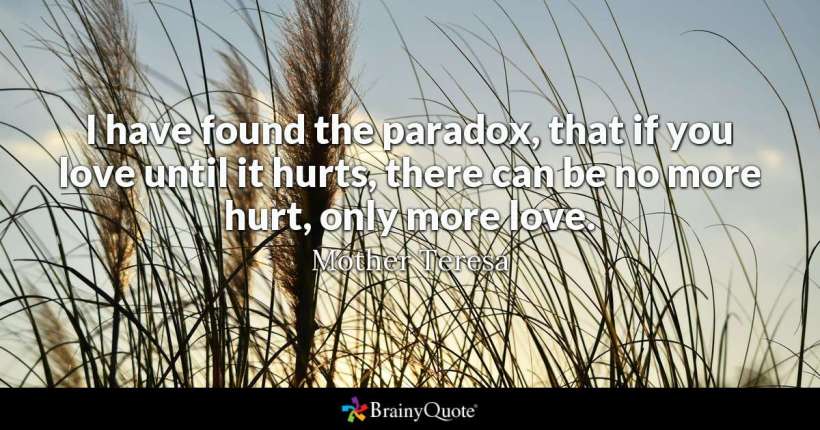
Mother Teresa once said, “Let no one come to you without leaving him better.” What a great reminder, a wonderful intention to set. It’s another way of saying I must learn to keep judgement from my heart and  love my neighbor as myself. Today, I choose to open my eyes, remove them from myself, and focus on others. Albert Schweitzer said, “Until he extends his circle of compassion to include all living things, man will not himself find peace.” I will need to choose this attitude over and over again. Each time that I practice, it will become easier to leave others better after our encounters. I can be a small part of making peace on earth with my own two hands.

Strong Hands, New Eyes…

Oscar Wilde once said, “It takes great courage to see the world in all its tainted glory, and still to love it.” This truth often strikes me, for, on a daily basis, I am amazed by the beauty and kindness and inspirational perseverance around me. On an equally frequent level, I am confronted with woundedness, ugliness, and hypocrisy. To hold the tension of this world’s  “tainted glory” well takes great balance and skill. Whatever and whoever there may be in my own path, I am quick to judge, to praise or condemn, to choose a personal response that has the potential to fall on either end of the spectrum.


Whether in line at the post office or the supermarket, driving, walking in the beautiful mountain town where I live, or working, I cross paths with many I choose to ignore. How many do I encounter every day who are longing to be seen or heard or helped in some way? Most often, I choose to believe that my schedule is too busy, my hands are too small and weak. I allow my eyes to cloud over and my mind to wander back to its self-preoccupation.


But what if my small hands are strong enough to offer a drink to the thirsty? What if doing so is the water my own soul needs? As David Foster Wallace says in his graduation speech entitled “This Is Water,” “Sometimes the hardest and most important realities are often the hardest to talk about.” In the petty frustrations of day-to-day living with narrow-sighted vision, it is only in choosing to look around with compassion that we find our own paths enlarged.


Just as  Jesus did, we are called, “…to preach good news to the poor…to bind up the brokenhearted…to proclaim freedom for the captives and release from darkness for the prisoners, to proclaim the year of the Lord’s favor…to comfort all who mourn, and provide for those who grieve…to bestow on them a crown of beauty instead of ashes, the oil of gladness instead of mourning, and a garment of praise instead of a spirit of despair” (Isaiah 61:1b-3a). God says that “…if you spend yourselves in behalf of the hungry and satisfy the needs of the oppressed, then your light will rise in the darkness, and your night will become like the noonday” (Isaiah 58:10).


Spanish-speaking artists Marcela Gándara and Jesus Adrian Romero have a beautiful song entitled “Dame Tus Ojos” (“Give Me Your Eyes”). In the song, they ask God, “Give me your eyes I want to see. Give me your words, I want to speak.” The song is a petition to be filled with the Spirit of God in every step. As we become Christ’s body and His church, may we literally be His hands and feet, see with His eyes, love with His heart.

***Photo Credits: Brainy Quote

Woven…

I think I’ve mentioned before that one of my favorite poems is called The Tapestry, by Corrie Ten Boom. One stanza reads: “My life is but a weaving, between my God and me. I cannot choose the colors, He weaveth steadily. Ofttimes He weaveth sorrow, and I in foolish pride, forget He sees the upper, and I the under side.” This is such a profound poem and life insight to me, especially as written by a woman who survived the horrors of Auschwitz, but saw her family perish there. Though, they weren’t Jews themselves, they were imprisoned for providing “a hiding place”, as her memoir is entitled, to the Jews within Holland.


In my own relatively peaceful and unscathed life, still I find that the majority of life is lived as this beloved author painted it, looking at the messy underside of a weaving. The tapestry may indeed be masterful, but from the limited vantagepoint of earth, the larger picture is hard to see or understand. I cry out when a pattern I’ve begun to be able to see or become attached to is suddenly disrupted, or when one color is torn to make room for another that doesn’t seem to belong. I question why so many messy threads hang down and why it’s all such mayhem. I’m ever striving for a tidier picture than the one I have, and a semblance of control. It rarely makes any sense what is happening through my lens. Believing that it’s all a part of “a grand design” takes a giant “leap of faith” most days.

 
But then, there are those moments, when the master weaver beckons to me from the other side of the tapestry, and allows me to come and take a peek at His view. Just for a moment, I see the smile on His face and the twinkle in His eye. I get to take a seat with Him as He points and gestures to the pattern He’s designed and woven. And oh my, how it takes my breath away. A chill crawls down my spine and tears fill my eyes, for I can see that all along, there really has been a plan, and He really is an artist, and every stitch has been joined with the utmost care for its ultimate great beauty and purpose. It’s all sooo beautiful, and He’s been arranging and composing it all along. He looks into my eyes with joy, and I can only look back into His with regret. I’m filled with sorrow for the many moments, or if we’re really being honest here, the lifetime of moments, I’ve filled with distrust. He knows them all, and knew them all when He designed this glorious pattern for me, and yet still, He counted me worthy to be woven into the fabric of His plan. This inclusion, this composition, this revelation…these are His gifts to me. These are the manifestations of His love for me.

An Iron Will: A Tribute to Georgine…

Tomorrow is Independence Day, a celebration of what it means to know free life. The Fourth of July marks not only that for me: it is both the anniversary of a friend’s spiritual birthday in 1950, as well as that of her “home-going” sixty-four years later. She’s been gone for three years now, and it still doesn’t seem possible that’s a reality; I can hear her voice as if it were yesterday. From the day I met her when I moved to this area in 2008, she said I was a kindred spirit and adopted me as a granddaughter. She called me her “Sweet Pea”; I called her my “Mama G”. She reminded me of the grandmother I lost when I was nine years old: Mama G’s quiet strength, obdurate determination, compassionate presence and vocal faith mirrored those of my Grandma Thelma. I was instantly at home with her.


Mama G was an example of the faith and perseverance of the saints to all who knew her. She modeled for me how one could live well with serious illness, something she coped with admirably for almost half her life: the chronic and inflammatory autoimmune disease Lupus targeted her as a young mother. Everything she did over the next decades came at a cost, but she counted it all worthy of the price she paid. She told me often with great sincerity that she counted it a true joy to share even a small bit of the suffering that was our Lord’s, and she lived out its truth. Her best friend says she had an “iron will”. As Proverbs 27:17 says, “As iron sharpens iron, so one man sharpens another.” She helped all her loved ones (in other words, everyone she knew) to be shaped into the mold of our Savior. In the spring of 2014, she contracted pancreatic cancer, the same disease took my Grandma Thelma’s life. They say it’s the most painful way to die: since the pancreas sits on a bundle of nerves that travel throughout the whole body, its sensations are akin to those of crucifixion. Though a nerve block relieved that pain for a while, in the end she suffered its fullness. Again, she counted it all joy and faced it with that iron will, her eyes on Jesus. A few short months later, she went Home to be with God. In life and in death, she celebrated free life that did not come without a cost; her soul at last found its final rest. 


I am only one who loved this precious woman of God, she was precious to many, but I remember and miss her every single day. As I face each new dawn and dusk, I hear the words to one of her favorite hymns Carolina Sandell Berg, modeling the acceptant trust with which she lived all the days of her life, Day by Day:


Help me then, in every tribulation,

So to trust Thy promises, O Lord,

That I lose not faith’s sweet consolation,

Offered me within Thy holy Word.

Help me, Lord, when toil and trouble meeting,

E’er to take, as from a father’s hand,

One by one, the days, the moments fleeting,

Till with Christ the Lord I stand.

The Body of Christ, Crucified…

Church is important to me, and at least until my health became poor several years ago, I was very involved in ministry within it. Lately, however, I’ve been discovering I feel pretty apathetic towards it. I still love to worship in it, to raise my voice in song and take communion with others, to listen to messages that dig deep into the Word. To be quite honest, though, there’s something about it that can be so exhausting. The people who inhabit churches can be so broken, as we all can be. On the flip side, I’ve also been the recipient of generosity, grace and lots more love than I could ever deserve from people within churches. I’m not meaning to throw punches, and certainly have no right to cast stones; I know I can’t remain in apathy or disconnection, and that my eyes should be on God alone. It seems, however, that if there’s something to this whole faith thing, and I know that I know that there is, there should be something different about church.


I remember reading somewhere years ago, though I’m not sure of the source, an explanation of church that has helped me in accepting this, or at least it made it all so much more comprehensible. It explained that the Body of Christ, the Church, is still the broken body of Christ. Though often filled with wonderful and well-intentioned people, and inhabited by the Holy Spirit, the Church will not be the resurrected and perfected Body of Christ until the day our Savior returns. One day, we too, shall be like Him; for now, we are all still being sanctified. Sometimes, as when the church welcomes all into its doors and steps out into communities and preaches with actions and not just words, reaches out its hands to help those in need, we are like Him even now. Others, we are broken and bleeding and wounded…but still, the blood flows down from the Savior who died to bring all men to Him. As the band Casting Crowns said in their song “If We Are the Body”, may we continue striving to be His arms reaching, His hands healing, His words teaching, His feet going, His love showing [the world] there is a way.


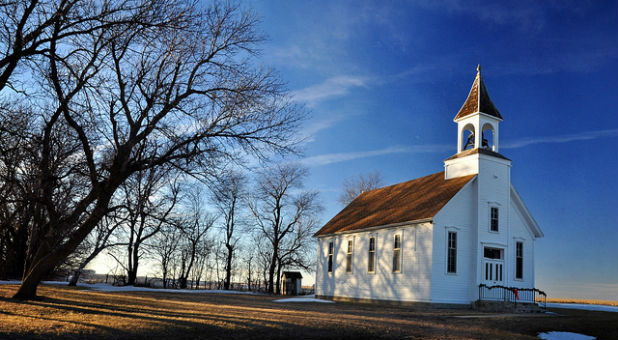
Photo Credits, & an Interesting Article: http://www.charismanews.com/us/53715-study-thousands-of-churches-closing-every-year-but-there-is-a-silver-lining

Just a Farmer…

He’s always said he was just a farmer. Just. As if that were a simple achievement.  Many before him had tried & failed to make 160 acres of Iowa land their own. He tilled his own land for many years in a time when the corporate U. S. farmers began to really take things over. Hanging on to one’s own land required a steady touch & hard work, strength & patience, resilience & perseverance. In order to mold the land, one had to be willing to be molded by it. Those who would tend to that rich Iowa farmland produced strong crops of corn & soybeans. Those who could surrender to the land’s natural rhythms found themselves enlarged in kind; their lives yielded faithfully, just as the fertile soil.


He was only a soldier who did his duty. Only. Alongside many others, he helped to turn the tide of evil & tyranny that threatened to consume the earth in its second world war. My grandpa’s quiet humility is typical of what has been termed the greatest generation. in 1942 at the age of twenty, he’d enlisted in the U.S. Coast Guard & trained in Baltimore before being stationed at the largest U.S. naval base in Norfolk, Virginia. Though he could have remained stationed there, he asked for sea duty. In times of peace, the Guard stayed close to our shores, but in World War II, it came to the aid of all our boys stationed throughout the world. As a small part of efforts to bring aid & transport troops, he’d crossed the Equator many times, passed through the Strait of Gibraltar, Suez & Panama Canals. His ship sailed to Calcutta, India & what is now Pakistan, had seen the Philippines & much of the South Pacific by the time he got out in 1946. They were crossing through the Strait of Gibraltar when they learned the war was over in ‘45. All his brothers & brothers-in-law had also joined up, & they all came back home safe, never forgetting how fortunate they were to have done so. That simple Iowa farmer had seen the world, had been a part of saving it.

Lovers of Peace…

“Act justly. Love mercy. Walk humbly with your God” (Micah 6:8). These are the qualities God asks us to demonstrate with our lives when He is asked by His people “What does the Lord require of us?”. This word comes in the Old Testament, an age that was under the Law. Even from then, the things God asks of us are really quite simple, but most certainly, simultaneously quite profound. In a way, they can be summed up in a code of peace. We are to have peace with God, peace with others, & peace within ourselves. If that peace exists, these qualities will be consistently demonstrated in our lives. In the New Testament, Jesus & his disciples often command us to be lovers of peace, & peace is also delineated as one of the pieces of the “armor of God”. Paul tells us to put it on every day in Ephesians 6:15: “having shod your feet with the preparation of the gospel of peace.” The Gospel simply means “good news”, & we associate this with God’s gift of salvation from our sins & darkness through the sacrifice of His Son Jesus.


But…there’s a piece of this armor that I’ve often missed. Not only does donning God’s armor mean we are equipped with that Word of the Gospel…it also means we must demonstrate the PEACE that news brings to our lives (The Armor of God, Priscilla Shirer). That PEACE is what speaks into the hearts & minds of those around us. It’s what equips & empowers us to live in hope & life. If we don’t demonstrate it, then we’re not “speaking” His good news to the world in action & deed. Perhaps that means we’re not truly allowing His Spirit to empower us in the moment-by-moment living. Another piece of good news, however, is that this peace is not something we can produce on our own, it is described as a fruit & byproduct of His Holy Spirit working in us (Galatians 5:22-23). After accepting His salvation, all we must do is allow His Spirit to work within us as His vessels. We must simply allow His PEACE to PERMEATE our hearts & minds & souls if we are to offer it over & over again to a broken world living without His hope & His life. I want to soak it in, and let it permeate my thoughts…and heart…and words…and relationships.

The Gift of Presence…

There’s a faithfulness in presence. On the other side of my Grandma Thelma’s kitchen, and the table she always seemed to have prepared, sat Grandpa Ray in his screened back porch. No matter when we’d arrive for a visit, there he’d be in his chair, calmly smoking his pipe, ever composed and even-keeled. He never seemed caught off guard: throughout each day until supper and sunset, there he remained sentinel, regardless of what moved around him. He wasn’t an excitable man, and despite having spent his life as a barber, he wasn’t a talkative one. Even as a child, I wondered why he held himself aloof, always a bit removed even from those he loved most. I still know relatively little about his life, beyond the fact that he married my grandma when my dad was in high school, after my dad’s biological father had passed away. Grandpa Ray was the only paternal grandfather I knew, and though he never said he word, I knew he adored us. He  died soon after Grandma passed, so in my mind and in that reality, he was always with her.
Though I never understood his cautious engagement with life and people, I think it was through him that I first learned that presence itself is a gift. Grandpa Ray was an observer of the quiet and beauty around him, enjoying his vantage point of the lane through the apple orchard and the bluff of southwestern Wisconsin. More than that, he regarded relationships and life with acceptance and wisdom. On the rare occasion where he would choose to comment, it was clear he’d been paying attention all along, and his voice was respected. “[His] good opinion [was] rarely bestowed, and therefore more worth the earning” (Austen, Jane. Pride & Prejudice). Though he was a man of few words, on the rare occasion he was out of the house, it felt rather empty without him. By the time I knew him, and perhaps before, he’d realized he could do little to control life, little he could understand of it. Still, he faithfully offered his attendance, and stood beside us all; his was the faithful gift of presence.