Blog

Places…

It’s hard to believe that it’s been seventeen years this month since I came to the beautiful mountain town where I live. A teaching job brought me to this gorgeous land of enchanting mountains, wandering trails, captivating wildflowers, melodious streams, and above all, a unique people. After living here for several years, I left once so that I could find a place where I could afford to buy a home, only to return two years later to the place that truly felt like home. 

    Unlike the students that I teach, I didn’t have the opportunity to grow up spending my winters skiing these stunning peaks, camping in the stark Utah deserts during the springs, or passing the summers wandering the mountains and rafting the rivers and biking the trails. I grew up in cities of both the midwest and Colorado’s Front Range. Once I reached Colorado’s Western Slope for college and became acquainted with its small-town mountain life, I knew I was home. For me, this is a FOUND PLACE–one I journeyed to and made a life in, like many others.

    As a former history major, I’ve often been fascinated by the theme that people shape places, and places shape people. I see it in the beautiful sun-etched lines, tanned wrinkles, toned bodies, and large smiles of the people here. I see it in my former students who wander far, have a passion for travel and adventure and the outdoors, who live in other places for a time, but who often find their way back home. The FOUNDATIONAL PLACES that gave them roots also provided them with wings.

    For me, when I see the big rivers and lakes of the midwest, the colors of the hardwoods in the fall, or walk or drive through a cornfield like those of Iowa where my grandparents once farmed, sweet memories wash over me and take me back to the innocence of childhood. Fog reminds me of driving through the bluffs on the way to my other grandmother’s home in southwestern Wisconsin, which sat on a hill where there was a small orchard. My siblings and I would walk through a screened in back porch where my grandfather was usually smoking his pipe to find my grandmother at work in the kitchen. 

    Places that have stretched, shaped and enlightened us can also be NOSTALGIC PLACES. I lived in Puerto Rico for a short time on a couple different occasions, and then taught English and served as a missionary in the Dominican Republic for a little over a year. Years later, I spent a summer in Costa Rica. These experiences gave me a great love for Latin America and its people, the Spanish language, and the ocean. They were also some of the most refining years of my life, for I was being reshaped by different places and people, but stretched in ways that redefined me. 

    And then there are places of IMAGINING AND WONDERING, places that call a deep longing within us that we often can’t quite name or identify. I’ve also been fortunate enough to have the opportunity to travel to Spain on a few occasions and cannot begin to express how much I love this country. I’ve only ever been for several days at a time with a group of students, but each time, it has felt as if I’m made to be there. Its deep layers of history, the beauty of its people and architecture and geography, the amazing food and the gorgeous language–they’re all so captivating. Returning there this summer with students nourished my soul in ways I can hardly express.

    We all have those places that captivate and inspire us. Perhaps it’s home–perhaps it’s somewhere new, but may we let ourselves be continually shaped by the beauty around us, and may we all find ways to contribute to that beauty. As the great author Wendell Berry says, “I am always surprised, whenever I look back on times I have known to be worrisome or troublesome or hard, to discover that I have never been out of the presence of peace and beauty, for here I have been always in the world itself.”

    “There’s Just Something About That Name…”

    For the past year or two, my toddler daughter has been obsessed with the Gaither Trio’s song “There’s Just Something About That Name.” My mom introduced it to her and we’ve listened to it on repeat so much at bedtime that I made it into the Gaither’s “Top 100 Listeners” last year. 

    Although I’ve always loved the song, at this point, it would be tempting to grow a little weary of it. Because of its powerful message, however, I know I can’t allow that.

    “Jesus, Jesus, Jesus–well there’s something about that Name.

    Master, Savior, Jesus–like the fragrance after the rain….

    Kings and kingdoms shall all pass away, but there’s something about that Name.”

    Indeed, there’s something about the name of Jesus–a name that has called and captivated me all my life, as it has many others. Despite sufficiently challenging personal circumstances throughout the majority of my time here, Jesus continues to call out my trust and because He holds my heart. 

    I love that it is the same for my daughter. Already, approaching the age of four, she has very sincerely invited Him into her heart. She speaks of Him constantly, with awe, but also as though he is her friend and confidante. May I continue to do the same.

    Jesus–the Son of God who came to earth to live as man and lead a blameless life, who suffered an unjust punishment so that He could bear the weight of all our sins on the cross, who endured suffering and persecution though He is King and Ruler of all. Jesus. As Isaiah the Prophet foretold, 

    “For a Child will be born to us, a Son will be given to us;

    And the government will [arest on His shoulders;

    And His name will be called Wonderful Counselor, Mighty God,

    Eternal Father, Prince of Peace” (Isaiah 9:6, NASB). 

    One day, every knee will bow before Him and we will all worship forever before Him in awe of His power and holiness, but most of all, of His love. “Jesus, Jesus, Jesus–there’s just something about that Name.”

    “Just As I Am/Tal Como Soy”

    I can still remember the sound of my grandmother’s aged, beautiful, magical, and throaty voice singing the stanzas of the hymn “Just As I Am” as she washed dishes and looked out the window of her Wisconsin home. I was right at her side rinsing and drying, but as her gaze alternated between the items she scrubbed in the hot sudsy water and the trees outside, she was somewhere else entirely.

    Perhaps this is why this hymn remains one of my favorites. It’s also one of the few remnants of my childhood piano lessons that I still play a crude version of on the piano. I’m no longer the small, innocent child standing at my beloved grandmother’s side, but a middle-aged adult who is much more familiar with all the highs and lows, success and failures that this roller-coaster of life brings us. The song now resonates with me for more reasons than nostalgic memory.

    Written by Charlotte Elliott in 1835 and composed by William Bradbury, “Just As I Am” gained new popularity when Billy Graham used it consistently as the invitation hymn in his crusades. How appropriate, for it perfectly describes what it means to to see ourselves as sinners in need of grace, desperate for the pardon of a Holy God. We are humbled that God not only grants it, but sacrifices His beloved son to death on a cross so that we might receive it. 

    This past summer, I had the words “Tal Como Soy”, the Spanish translation of “Just As I Am” tattooed on my arm to remind me of God’s grace and mercy, but also of His unconditional acceptance of me as His daughter, regardless of my shortcomings, mistakes, and circumstances.

    In the past few years, I have known what it is to be rejected by close family and friends, simply for placing some much-needed boundaries in my life. This injured me at the deepest levels and has been enough to make me completely question my identity and perception of reality. Although I acted out of my personal conviction and understanding of God’s leading, as well as the results of everything learned in several years of therapy, these things weren’t enough to protect me from distorted versions of what happened or to help me escape harsh judgement. I attempted to take responsibility for my roles in these situations and to apologize, but those too seem to have disappeared into thin air. I’ve heard that boundaries can be described as the distance between which I can love both myself and another person well. Somehow, those I’ve been in conflict with missed seeing the love and health in the situation.

    And so, the tattoo–to remind me daily that however I got here, I’m loved and accepted by my Savior just as I am.

    Out of all the lullabies, songs and hymns that I have sung to my daughter at bedtime, “Just As I Am” has been one of her favorite requests over the past year. What a gift from God that I am so compelled to dwell, almost nightly, on the words. One of my favorite verses begins, “Just as I am though tossed about, with many a conflict, many a doubt.” How true, and yet these lead me through the journey of acceptance. I must learn to accept myself and my circumstances, and above all, accept how God sees me and the ways He is working.

    Songwriter, singer, and worship pastor Jesús Adrian Romero has a beautiful song called “Tal Como Soy” (“Just As I Am”). In it he sings, “Just as I am, Lord. I have nothing to give but my heart” (My translation). How true. And so Lord, here is my battered, bruised, and misshapen heart. I’m all yours–do with me what you will.

    “A Parachute of Love”

    An old song by the King Cole Trio says, “The greatest thing you’ll ever learn is just to love and to be loved in return.” How true this is. It is indeed the greatest journey and learning experience of life. We were created out of love, and out of love we are sustained and made new. And yet, because of the broken world we live in and the difficult experiences we share, many of us struggle to accept or give love as we should.

    I’ve often been told that the place to begin is to learn to love ourselves–to accept the infinite love God has for us. This LOVE was great enough for Him to send His only son to the cross to die for us, LOVE great enough to forgive us every mistake and flaw, LOVE that knew us and wanted a relationship with us before time began. I John 3:1 says, “See what great love the Father has lavished on us, that we should be called children of God!”

    My therapist recently suggested that a good exercise for me would be to look in the mirror at least once a day and say, “I love you.” to myself. I laughed when she said this because it sounded like such a silly idea to me, but said I would try it. Actually doing it was MUCH harder than I expected–I found myself sobbing in the mirror because I couldn’t say the words. At that point, I realized how much I needed this practice as a means of forgiving myself and all those who have not accepted or loved me as I needed. It’s a means of placing radical trust in God and the worth that He says I have in Him.

    A former mentor once asked me how many people were allowed on who I am. With that question, I realized that I was allowing everyone a vote, that my worth could be easily shattered by the opinion of someone I barely knew. Twenty years later, I’m not sure how much I’ve grown. I probably don’t let strangers vote anymore, but I seem to allow almost everyone who knows me, be they friend or foe, some sort of say. Looking back, I can see the way God built me up with friends and mentors and encouragement in my early twenties, then  allowed me to be torn down again and stripped of all that approval in various ways. One day, I will learn that His approval is all that I need–His vote is the only one that truly counts.

    Nathaniel Branden said, “Self-acceptance is my refusal to live in an adversarial relationship with myself.” Seeing it put that way, I’m aware of how often my thoughts are self-critical and how that really means that a state of civil war exists within me. In order to find peace, I must come to terms with all the bits that are hard to accept, with all the bits that others haven’t liked, with both my humanity and my divinity. I must, as William Stafford said, “…[weave] a parachute out of everything broken.” As the band Macaco sings in one of my favorite songs “Un Mundo Roto/A Broken World”, I mustn’t let this broken world destroy my smile.

    One of my favorite authors, Leeanna Tankersley wrote something that captures my intention:

    “A voice is whispering to me as I watch the river…let it happen. Let it happen to you. The losing, the finding, the falling apart, the coming back together. All of it. Sit very still. Keep breathing. And let it happen.”

    Sparrowsong

    ”His Eye Is on the Sparrow”, written by Civilla Durfee Martin in 1905, has long been my favorite hymn. The anthem chorus captures the most fervent longing of my heart:

    “I sing because I’m happy—I sing because I’m free;

    For His eye is on the sparrow,

    And I know He watches me.”

    I have birds all over my home and jewelry to remind me of this truth—God’s compassionate and loving  eye is upon me, upon each and every one of us.

    This is an easy truth to proclaim—a much harder one to believe and live. The first verse of the hymn begins by echoing the cries of Psalm 42:11: “Why are you downcast, O my soul? Why so disturbed within me? Put your hope in God, for I will yet praise Him, my Saviour and my God.”

    I have three friends currently battling cancer. One has a toddler and a new baby; one has children in elementary and middle school; one just sent her “baby” off to college. Another dear friend who is disabled just lost her husband and caregiver after fifty-three years of marriage. I am navigating my own challenges. And these are all first world problems, to say nothing of the intense struggles of those in places like Israel, Palestine, and Ukraine.

    But the apostle Peter told us not to be surprised at the fiery test we would undergo. Jesus told us, “In this world you will have trouble. But take heart! I have overcome the world” (John 13:33b). And in His Sermon on the Mount, Jesus assured us that not even a sparrow falls without His notices. He told us not to worry for our needs, for He splendidly clothes even the lilies of the field.

    So often, I feel burdened by the weight of life’s trials. In Isaiah 40: 27-31, the prophet admonished God’s people:

    “Why do you say, O Jacob, and complain, O Israel,

    ‘My way is hidden from the LORD, 

    And the justice due me escapes the notice of my God’?

    Do you not know? Have you not heard?

    The Everlasting God, the LORD, the

    Creator of the ends of the earth

    Does not become weary or tired.

    His understanding is inscrutable.

    He gives strength to the weary,

    And to him who lacks might He increases power.

    Though youths grow weary and tired

    And vigorous young men stumble badly,

    Yet those who wait for the LORD

    Will gain new strength:

    They will mount up with wings like eagles,

    They will run and not get tired,

    They will walk and not become weary.”

    Spring arrives slowly in my neck of the woods, but despite the fluctuating and unpredictable April weather, the birds have returned. Their joyous calls, regardless of winds and storms, remind me to join in song.

    We Serve…

    Life is always such a glorious, yet difficult mix of things. I have a temperament that struggles with navigating these complexities. As my all time favorite literary and film character, Anne of Green Gables and Avonlea says, “I can’t help but soaring up on the wings of anticipation, only to come crashing down into the depths of despair.”  Whether because of innate personality or learned responses to experiences or both, I tend to ride the roller coaster of life feeling deeply every bump, climb, curve, and fall.

    Recently, I’ve soared because I was granted a home in the town that I love. The ability to sign its contract came about through several miraculous events. My friends’ extreme generosity in assisting with the total cost ultimately made it possible for a single mother and teacher to live in an expensive mountain town. The amount of money needed was inconceivable to me, so I feel very blessed and grateful to be able to raise my daughter here and stay in this community that I’ve loved for over a decade and a half.

    At the same time that this came about, I’ve been extremely physically sick and have also needed to walk through more of the complex and weighty realities of divorce. Allowing my toddler to spend the night with her dad and away from me feels as if a piece of me is literally missing. Although I know I played a role, I had no control over so many realities that brought us to this place, and there are so many things in the present and the future that I am also unable to control. For myself, that is one thing, but when it impacts my child, it is quite another.

    Yet to all my joy and worries and fears and complaints, a very dear friend responded simply, “We serve a God who is in charge of all things.” I must admit that her response felt a little callous. Deep down, I knew she wasn’t being dismissive of my pain. As a devoted mother, compassionate friend, and faithful follower of Christ, I knew she empathized with my struggles. It felt extremely difficult, however, to hear this hard truth shared in response to my heartbreak. I imagine the twelve disciples often felt this way when Jesus shared life-shattering truths with them. Yet how could He offer anything other than Himself? 

    I know that many people experience much more difficult things than I have, awful things that defy my comprehension and cause most people to deny that God is at work for their good. I don’t know how to explain those events nor all the circumstances in my life that have worn and torn out my heart. 

    But we serve God, He does not serve us, for He is God and we are not. In His supreme, complicated, and glorious sovereignty, it is He who permits, and orders all things. No matter how awful or hard it feels, we must trust that it is God who is shaping us, who is constantly simultaneously at work for our good and for His glory. 

    As Bebo Norman wrote and sang in THE HAMMER HOLDS

    “So dream a little dream for me in hopes that I’ll remain. 

    And cry a little cry for me, so I can bear the pain…. 

    My dreams are not the issue here, for they, the hammer holds.”

    HOPE–A Thorny Bloom

    My yard is blessed by an overabundance of thistles–probably my least-favorite plant. With all the rain and wind we received in the late spring in our region this year, a few thistles multiplied to literally hundreds seemingly overnight. Thorny and prickly and nearly impossible to pull out without the right tools, gloves, and technique, they still seem to defy me and grow back the next week to impede the paths around our home and poke my toddler as she explores the yard. 

    For all of these reasons and more, I was sure for the longest time that the thistle is a weed, and not just any old weed, but the meanest and most noxious weed of them all.  After noticing lovely blooms on the taller thistles around the area, however, I looked it up and was surprised to learn that it is a highly valued and beneficial flowering plant whose prickles simply help protect it from being eaten by herbivores. Not only that, but according to Wikipedia, “Biennial thistles are particularly noteworthy for their high wildlife value, producing such things as copious floral resources for pollinators, nourishing seeds for birds like the goldfinch, foliage for butterfly larvae, and down for the lining of birds’ nests.”

    It made me wonder if the thorny plants in my life have benefits too, despite the mild suffering that comes from being pricked by their thorns. I’m reminded of Romans 5:3-5: “And not only this, but we also exult in our tribulations, knowing that tribulation brings about perseverance; and perseverance, proven character; and proven character, hope; and hope does not disappoint, because the love of God has been poured out within our hearts through the Holy Spirit who was given to us.”

    This passage mystified me when I stumbled across it as a young adult digging deep into Scripture, for I was already naively hopeful and had suffered very little. I thought it strange that the Apostle Paul listed hope as the end result instead of the starting place.

    Now, as a more seasoned believer who has had the wind taken out of her sails a few times, I understand. The “hope” I experienced as a young woman was really more like youthful optimism that cracked several times under pressure until it eventually shattered, revealed for the ingenuine thing that it was. It is as the Apostle Peter said in I Peter 1:6-7, “In this you greatly rejoice, even though now for a little while, if necessary, you have been distressed by various trials, so that the proof of your faith, being more precious than gold which perishes though tested by fire, may be found to result in praise, glory, and honor at the revelation of Jesus Christ.”

    In times of suffering, there are times when it has been difficult for me to face it with character or to persevere in it and continue to put one foot in front of another. But Paul was right–the most difficult thing by far is to hope. Peter tells us to count it all joy that we are able to share in the suffering of Christ. Easier said than done, certainly. But what joy it is that the end result of it all is that blessed and elusive thing–genuine hope. Even the thorny thistle has the most lovely, vibrant, purple bloom. As Emily Dickinson said, “Hope is the thing with feathers that perches in the soul – and sings the tunes without the words – and never stops at all.”

    “To Soar on Shifting Sand”

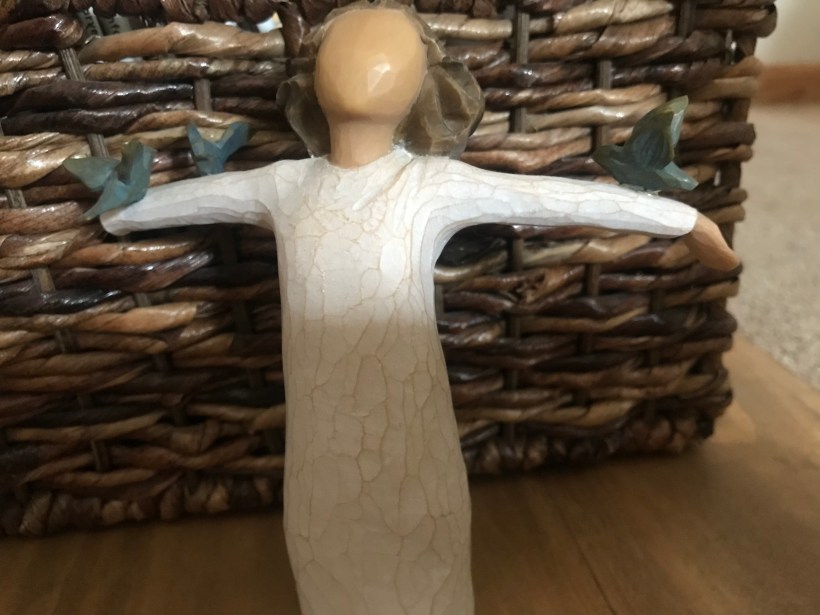
    I’m a big fan of the WILLOW TREE figurines by Susan Lordi. Though they’re produced en masse, the originals are simple wood sculptures of people or angels that capture much of the range of human emotion. My favorite is called “SOAR” and features a woman with her joyful face angled towards the heavens, her arms stretched out wide, birds resting upon them.

    I bought this figurine a few years ago in a season when I yearned to experience such freedom and needed the daily visual reminder that it was possible to soar. Over the last year, as my bird-loving toddler grows, “SOAR” has unfortunately taken quite a beating. I feel sad when I look at SOAR now, scratched and bruised, missing a hand and one bird, other birds replaced by glue. It feels like I’m in a similar condition. It’s easy to imagine I’m broken beyond repair, grounded for life, or unworthy of public viewing. And yet, I also note that despite how SOAR has been beaten and bruised, her arms are still raised, her face ever victorious and turned towards the sun.

    In her book RISING STRONG, author Brené Brown discusses the concept that our culture is one that can value failure IF it leads to victory, but that we also easily gloss over the feelings of defeat, frustration, angst, loneliness, and struggle that so often accompany failure. We often forget that this is a place many of us stay in for a season or seasons, but that it is possible to rise up strong from it. I’m trying to have faith that I can do so too.

    Early on in my adult life, I thought of myself as a person of strong faith. Although it was clear I didn’t have the mustard seed size required to move mountains (Matthew 17:20), it felt possible to eventually grow to that level. All it has taken, however, is a series of many trials over the years to knock the wind out of me. I know now that my faith is either non-existent or infinitesimally small. Like the SOAR and Moses, my arms have grown weak and weary and I have often needed others to hold them up. The friends who have done so are a big part of why I’m still holding on in the times when I can’t discern God’s hand or purpose.

    If faith…is like shifting sand, changed by every wave… as the band Caedmon’s Call sings, perhaps the waves that continue to crash in can continue to shape it and make it something new, something pure and refined, something that isn’t mine at all. As Hebrews 12 says, God is “…the author and perfector of my faith.” Will He ultimately make it full and complete? The apostle Peter also tells us, “But this happened so that your faith, of greater worth than gold, may be found perfect and complete” (I Peter 1:7).

    The final word on this subject for me, however, was written by the prophet Isaiah: 

    “Why do you say, O Jacob, and complain, O Israel, “My way is hidden from the Lord, my cause is disregarded by my God”? Do you not know? Have you not heard? The Lord is the everlasting God, the creator of the ends of the earth. He will not grow tired or weary, and his understanding no one can fathom. He gives strength to the weary and increases the power of the weak. Even youths grow tired and weary and young men stumble and fall, but those who hope in the Lord will renew their strength. They will soar on wings like eagles, they will run and not grow weary.” Isaiah 40: 27-31

    ”Gratitude”-

    One of my dearest friends gave me a large placard with the words “A GRATEFUL HEART IS A MAGNET FOR MIRACLES.” It’s been on my fridge for years now and still serves to encourage me to aspire to that consistent mindset. When I see it, I’m often reminded of the sweet friend who gave it to me, for her life is a beautiful example of this attitude. She’s not one of those falsely positive people who exude bubbliness with such force that it’s difficult to believe or emulate, she readily acknowledges when things are hard. But that’s not where she stays, regardless of circumstances.

    Unfortunately, I’m not as much like my friend as I desire to be. Though gratitude is one of the qualities I most admire and one I attempt to practice daily, my natural tendency is definitely to complain. This must be human nature–it’s work for all of us. I’m sure it’s my own weakness of character or years of practice that made it a hard-to-break habit. My gut tells me, however, that it’s most likely an intense struggle for me because my highly sensitive personality causes me to internalize trials deeply.

    My life hasn’t held more difficulties than most, yet the following passage from 66:8-12 describes my experience:

    “Praise our God, all peoples, let the sound of his praise be heard; he has preserved our lives and kept our feet from slipping. For you, God tested us; you refined us like silver. You brought us into prison and laid burdens on our backs. You let people ride over our heads; we went through fire and water, but you brought us to a place of abundance.”

    Within that Psalm that acknowledges great difficulty, there is both a call to praise and an acknowledgment of God’s ultimate faithfulness and provision. For that and many other reasons, I know I must continue to wage the war against my complaining nature, not only to cultivate the personality and character I desire to have and to be able to be the kind of example I want to be, but because the Psalms also tell me that I enter God’s gates with thanksgiving in my heart. A grateful heart is pleasing to Him “…in whom I live and move and have my being (Acts 17:28).”

    Every day, I try to journal about at least three things that I have to be thankful for. Research shows this practice is proven to impact our perception of happiness. It works for me! My outlook is often completely different after taking a few minutes to reflect on these items. When I practice it in prayer, it’s also something that helps me to land where I’m at, present in the moment I’m in instead of far behind or ahead, places I’m frequently drawn towards.

    Thank you, God, for the smell of rain drifting in through the windows and the cloudy summer sky. Thank you for the hot mug of tea beside me as I sit in my favorite chair, for the ability and time to think and write. Thank you for quiet and rest, for a healthy daughter napping after a fun morning together, for the sweet dog lying at my feet. Thank you for the dear friends who have stood at my side, regardless of circumstances,  despite my complaints and emotions. Thank you, God for your grace, your light, love, power, and presence.

    The same friend who gave me the miracle card recently sent me a link to “Gratitude,” a beautiful song by I AM THEY. They sing:

    “I know it’s not much, but I’ve nothing else fit for a King

    Except for a song singing, ‘Hallelujah, Hallelujah.’”

     “Dancing”–

    I’ve long viewed my relationship with God as a dance. Early in my life, He held out His hand to me in invitation. I often picture the scene in the old Disney cartoon ALADDIN where Aladdin rides up to Jazmine on his magic carpet, holds out his hand to her, and asks, “Do you trust me?” She looks at him, questioning if she can, then decides she will. She  jumps on for a ride that leads her to “A Whole New World.”

    I’ve returned to that moment over and over in my journey of faith. In the beginning, I naively jumped on without questioning, assuming it would be easy to trust and ride. At many other points, wondering if I could still handle the wild ride or disliking where the journey took me, I nearly jumped off and withdrew my hand. Despite often needing to trust God’s heart when I haven’t been able to see His hand or face, despite struggling to do so at several points, I know His invitation stands. Indeed, partnered with Him, I have seen sights I never could have expected otherwise.

    A wallflower to my core, it’s a wonder that He chose me. God sees the most unlovely, clumsy, and broken parts and continues to choose me. As I took Hook His hand, He brought me out of my shell and brought a smile to my face. He led and guided confidently when I didn’t know a single step or have any rhythm of my own. He taught me to ignore the crowd, close my eyes, and follow His lead. He allowed me to lean on Him and held me up when I grew weary. When I followed His lead, He made me look good. When I resisted and fought for my own way, I broke our rhythm and fell. Yet there He was to pick me up, time after time, and offer His hand again. And there’s nothing so beautiful or freeing as dancing with a good partner. 

    A new song by Elevation Worship, called “Dancing,” captures this experience and the promise I returned to Him: 

    “Dancing on the mountain of a victory; dancing on the valley of a broken dream;

    Dancing on the plain of the in-between; If it’s you and me I won’t stop dancing.”