
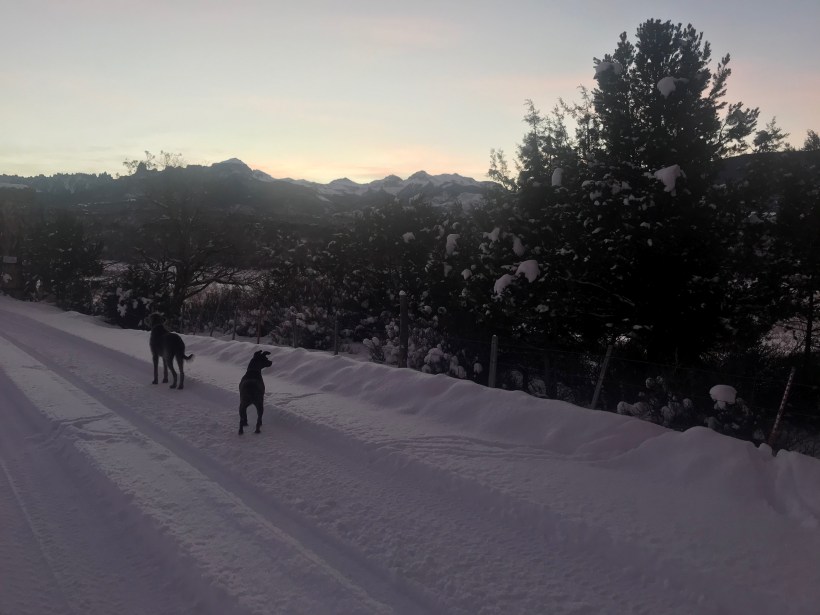
As I walked my dogs the other morning, I looked out onto a world made new. The crisp azure sky highlighted jagged mountain peaks covered in a dazzling fresh coat of snow. Cat Stevens’ song rang out in my mind, “Morning has broken, like the first morning. Blackbird has spoken like the first bird. Praise for the singing, praise for the morning….” Creation is continually sustained and remade, just as we are.
The new year and decade remind me that no matter where we’re at, whatever regrets we have or roads we may wish we had taken in the past, whatever has us feeling trapped or stuck, it’s always possible to find redemption for the areas in which we fall short and start over. As the great poet Rainer Maria Rilke prompted, “Let us believe in a long year that is given to us new, untouched, full of things that have never been.”
Leeana Tankersley writes about the prayer of St. Benedict used to call the saints of old to the holiness of repetition, “Always we begin again.” As an intention for each new year, day, or moment, it reminds us that all of life is about the openness for continual renewal. As Tankersley writes, “…that’s what so much of life is–learning how, and learning how again, over and over.”
Colombia has one of the oldest standing guerilla armies in the world and a long-standing internal conflict that has killed hundreds of thousands, affecting over nine million. Executive Jose Miguel Sokoloff and a group of peacemakers led their native country in transformation over several years during the holiday season.* Initially, they covered a path from the jungle where the guerillas hid with Christmas lights and left a message stating, “If Christmas can come to the jungle, you can come home. Demobilize. At Christmas, everything is possible.” The message worked and soldiers began to lay down their arms. The next year, Sokoloff’s group put bouncy balls that lit up into the rivers with personal messages inside from families who had soldiers fighting. Several soldiers a day returned home. Eventually, as many as 17,000 laid down their weapons.
If this kind of societal transformation is possible, what is conceivable within our own individual stories? Will we allow the things that break our hearts to also crush our spirits? Will paths that fizzle out become dead ends or opportunities to forge a new road? Will each new day be a reminder of the time we’ve lost or of all that awaits? Emily Dickins exhorted, “The soul should always stand ajar, ready to welcome the ecstatic experience…DWELL IN POSSIBILITY.” If we are open-hearted and open-minded, willing to embrace a life that will consistently surprise us and a Creator that will continually transform us, the possibilities are endless. We can always begin again.
*(1) Lisa Shipley, “Christmas after Christmas: How a Colombian ad exec helped demobilize guerrillas by advertising peace,” The Bogota Post, December 3, 2017.

 SparrowSong