The Dance of Surrendered Faith…

Sometimes living feels like a bit of a tightrope walk, doesn’t it? There are so many keys to staying the course and living life well. We need to be strong, but not hard or callous. We should be fun and relaxed, but also hard-working and disciplined. Flexibility is a must, but so is holding to and protecting our boundaries. There are rules that must be followed and those that, at least on occasion, appear to be made to be broken. Our culture sends us a whole slew of confusing messages on a daily basis, something that feels especially true for women. 

A friend said to me recently, “What a crazy dance life is.” She’s right, at least based on my experience–there is a great deal of craziness that keeps us spinning. But if it’s a dance, then there’s beauty in that, for dancing involves music, steps, rhythm, and hopefully, a fun partner who gently leads. Dancing can be a celebration. Entering in means embracing it for what it is, choosing to be led, choosing to be joyful in it.

Of all the crazy dances or tightrope walks in this world, one that I find the most challenging is the balance between faith and surrender. Jesus tells us that if we have faith as small as a mustard seed, we can tell a mountain to move and it will. He also tells us, “Ask and it will be given to you; seek and you will find…” (Matthew 7:7). Paul and other apostles applauded men like Abraham who, “…human reason for hope being gone, hoped in faith.. as he had been promised” (Romans 4:18). So, for example, I can pray in faith for God to heal me, believing that He can at any moment, but I must also walk in complete surrender, trusting Him to do His will. No matter how things appear, I believe that He is always at work for my good and for His glory.

Jesus tells us that as His followers we must take up our crosses daily and follow Him, that whoever desires to keep his life must lose it. Brother Lawrence, a saint of old, encourages us, “Complete surrender to God’s will is the only sure road to follow. In it, there is always enough light to assure safe travel.” We are told in the first chapter of Ephesians that we are seated with Christ in the heavenly realms and that, “…God placed all things under His feet and appointed Him to be head over everything for the church.” He has given us authority over all the things that trouble and plague us here on this earth, yet we’re also told that for a little while we must suffer. What a crazy dance life is.

In her book, When Things Fall Apart, Pema Chödrön expresses it this way, “…We think that the point is to pass the test or to overcome the problem, but the truth is that things don’t really get solved. They come together and they fall apart. Then they come together and they fall apart again. It’s just like that. The healing comes from letting there be room for all this to happen, room for grief, for relief, for misery, for joy…. Letting there be room for not knowing is the most important thing of all” (p. 9). 

Christ holds out His hand and asks, “May I have this dance?” I accept His invitation and embrace the journey. I surrender and make space, that I may be open for all that comes next, however unknown it may be.

*Photo Credits: lovedoes.org

Chain Breaking Words…

I keep a large journal in which I paste cut-out words and phrases that have meaning for me. They’re usually those I find in a magazine, many times coupled with a captivating image that grabs my attention or resonates in a particular way. 

The idea first came from something I read about working with teens. Adolescents often find it difficult to put words to what they’re feeling and experiencing, so it can be helpful to take out an old stack of newspapers and magazines and encourage them to cut out whatever feels true and inspires them right now, then paste it into a collage. It can be helpful to sit alongside them and do the same. My niece and I did the activity once at a time when she was closed off from meaningful conversation. When she stopped the activity after just a few words, staring at a mostly blank page, I was there to pass a few words on to her, reminding her she is amazing, beautiful, loved, and strong. It was a powerful experience, providing us windows into her soul and mine. 

Don’t we all struggle at times, in this busy world we live in, to listen to the whispers within? For this reason, this word search collage is a practice I’ve continued. Words have the power of life and death, and for many of us, there are words and lies we have believed about ourselves that have wrapped us in chains. This is one practice I use to break those chains. When I’m feeling the most hurried, disquieted, discouraged, or disconnected from myself, a pair of scissors, an old magazine, and my collage journal (preferably accompanied by Norah Jones or Hillsong), are welcome friends. Leafing through what I’ve pasted in my journal has the power to whisper back to me what my heart and soul are crying out for, what my core values and priorities are, and to remind me of who I truly am.

For example, on so many pages are images of smiling women in hammocks or on stand-up paddleboards, or sitting in comfy armchairs or front porches. The image of a woman at rest, enjoying life obviously calls to me, as do the words, “Rest; rejuvenate; sleep, reclaiming a place; simple ways to refresh; wholesome loving care from this day forward.” Words about being present sound out like a clarion call. “Revel in the great outdoors; watch the extraordinary moments unfold; discover the moment; life’s better when you’re in it; be there; mind every moment; make the most of your day.”

Other phrases remind me of what’s important to me, “Live with all your heart; create a lasting legacy; giving is good; unconditional love, getting closer; collect experiences, not things; always seek your inner light; look deep into nature.” Many remind me of my calling and encourage me to go after my dreams, “Find the perfect stories; stories are important and deserve to be told.”

There are those that say, “Live happily ever after,” or “The best is yet to come,” that encourage my heart to hope when it feels a bit low. Some, like, “Choose happiness,” which I combined with, “It’s time, right now,” that inspire me in my attitudes and choices. And others, “Take it outside; Dress like a box of crayons; Life is eating, laughing, and loving,” just remind me to have FUN. 
Sometimes I look through my book and am amazed to see the person buried deep inside me. At others, I’m just glad to see her again. My book helps me to hear Emily Dickinson’s voice nudging, “The soul should always stand ajar, ready to welcome the ecstatic experience…. Dwell in possibility.” Most often, the words whisper the voice of God, telling me His truth that supersedes any other voice, reminding me of His love that is immense and unconditional, speaking His words that break every chain.

“Just As I Am…”


Mistakes and failure seem to be a part of venturing bravely and wholeheartedly into this great big world, or just staying at home. I can’t say I’m thrilled about it. Over and over again, I come to the feet of God, the plea of Charlotte Elliott’s old hymn on my lips:


“Just as I am, without one plea,

But that Thy blood was shed for me.

And that Thou bidst me come to Thee.

O Lamb of God, I come. I come.”


As many times as I think I’ve accepted the fact that I’m going to make a million mistakes in this human adventure, the ugliness of failure hits me anew each time like running into a brick wall. Like author Anne Lamott, I must tape Hillel’s line on my wall, “I get up. I walk. I fall down. Meanwhile, I keep dancing.”


Nelson Mandela said, “The greatest glory in living lies not in never failing…but in rising every time we fall.” And I have this blessed hope. As I pick myself up and dust myself off, my loving Father greets me with His arms wide open. He looks at me tenderly, telling me without words that all is well, and all manner of things shall be well. He whispers that He has loved me with an everlasting love (Jeremiah 33:3) and I am completely right with Him through the blood of His Son (II Corinthians 5:21).


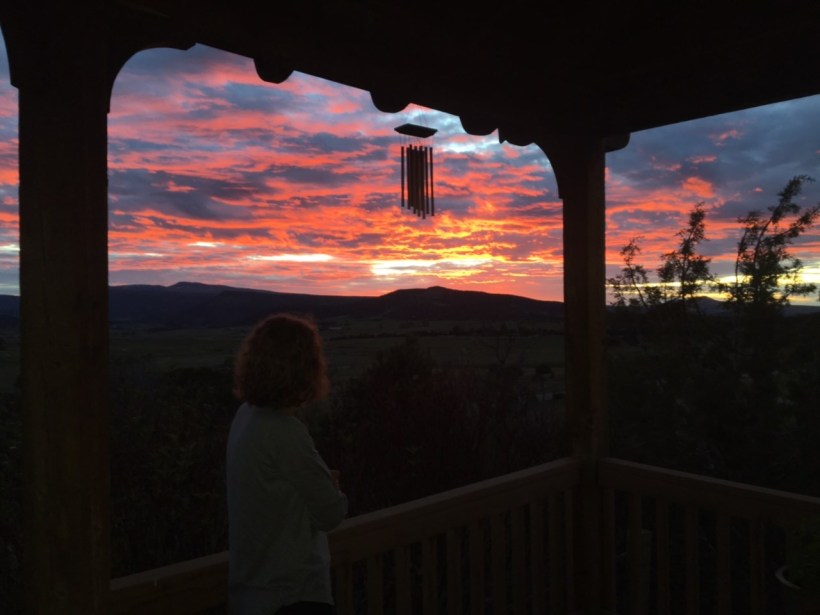
I walked yesterday, a few things troubling my spirit, the weather windy as a storm rolled in. As I rounded the corner to my house, a warm sunset greeted me. Pastel purples, pinks, and yellows stretched thin across the western sky. Just then, a small wren landed on top of my wind chimes and sat there bouncing joyfully in the wind. As he began his song, accompanied by both the stormy breeze and the chimes, silhouetted by the mellow evening sky, part of a favorite song came to me: “I sing because I’m happy, and I sing because I’m free. His eye is on the sparrow, and I know He watches me.”


That night I read a portion of Bill Holm’s poem Ann Lamott quoted in her book BIRD BY BIRD called “August in Waterton, Alberta,” and it connected these musings on failure and songs in storm:


“Above me, wind does its best

To blow leaves off

The aspen tree a month too soon.

No use wind. All you succeed

In doing is making music, the noise

Of failure growing beautiful.”


Though perhaps my time for success in certain realms has not yet come, if it ever shall, and the wind may blow all the while, my roots grow deep and my colors turn bright and beautiful. “Meanwhile, I keep dancing” (Hillel).

Let’s Be Still…

The past few weeks, I’ve been in a season of mandated rest. Thank God. This is what my body, mind, and spirit have craved for years, yet somehow, it’s a place I could not arrive at by myself. Why must I be forced to do what I most crave? A wonderful question, but still, undeniably true. I needed the help of being temporarily unemployed and recovering from unexpected minor surgery to get here, but alas, here I am at last.


I’ve learned to make my coffee and sit outside in the morning sun to read…to rest at midday…to walk more slowly and take in more of my surroundings and schedule fewer things…to quite sooner and push less. I can’t fully express how good it feels to give myself a little bit of breathing room and to have the gift of being able to do so. Not everyone gets this and I know I won’t always have it, so I am soaking it up with as much gratitude as I can muster.


Leeana Tankersley, an author I’ve been reading a lot of lately, writes about learning to be a companion to yourself. This is the art of treating yourself kindly, as you would a dear friend, instead of punishing, criticizing, and bullying yourself, as so many of us are prone to do. It’s occurred to me in this time that the driven pushing that is so much a part of my perfectionist personality is a part of that adversarial relationship with myself that I would love to leave behind. How do I learn to do this? Perhaps the answer is, at least in part, more simple than I expect…through stillness and breath. In her book, Breathing Room, Leeana Tankersley writes:


“The human body’s urge to breathe is irrepressible and essential. When we hold our breath, we begin to feel a pain inside our chest…called our critical line…. Our body tells us it’s time to exhale. Only then can we take in the air we need.  ‘As it turns out,’ a breathing researcher writes, ‘the opposite of holding your breath isn’t inhaling, it’s letting go.’ ”


So this is the key to providing the way to the spacious place in which I want to dwell—letting go. May it be so, and if only it could be as simple as saying it. I know each day I will need to teach myself anew to breathe, exhale, and let go in the moments where I most want to cling and tighten. The more that I practice, quieting my heart and opening my eyes to the beauty around me, the easier it becomes. As C.S. Lewis said, “The sweetest thing in all my life has been the longing…to find the place where all the beauty came from.”


My favorite band, The Head and the Heart, sing a song that captures it well called “Let’s Be Still:”


The world’s just spinning a little too fast

If things don’t slow down soon we might not last

So just for the moment, let’s be still

Embracing Uncertainty…

Kenko said, “The most precious thing in life is uncertainty.” That’s not quite how I would have phrased it. I might have said the greatest certainty of life is uncertainty or that it is the most difficult thing to accept, but the most precious thing? Really? That certainly puts things in a new light and gives me much to ponder.


A dear friend who lost her mother last week and her father just a few years before told me that the more she lives the more she realizes how much we have to cherish each day, for our lives can change in an instant. She’s also battled cancer and knows this all too well. On a national level, we see this in a country suddenly inflamed with acts of racial hatred and violence the likes of which we haven’t seen in over fifty years. Another beloved friend received devastating news about her husband’s health a few days ago. My heart breaks for them and I know that God weeps with me. What a paradox that the God who sits on the throne with all things under His feet allows these hard things yet comes to sit on the floor with us and help us (Leeana Tankersley). 


Events such as these remind us that control is an illusion. There are few things in life that we truly have authority over–our attempts at striving to control have limited if not damaging results. Author Leeana Tankersley writes, “Urgently fixing is not acting out of wholeness, it’s acting out of brokenness…. Working hard and working out of a place of anxiety are not the same thing…. If you can’t breathe, stop. Never move or act out of that place. Wait until you can breathe.”


One of the most life-changing lessons I have received is from author Brené Brown in The Power of Vulnerability where she offers ten guideposts for wholehearted living:


  1. Cultivating authenticity and letting go of what people think;
  2. Cultivating self-compassion and letting go of perfectionism;
  3. Cultivating a resilient spirit and letting go of numbing and powerlessness;
  4. Cultivating gratitude and joy and letting go of scarcity and fear of the dark;
  5. Cultivating creativity and letting go of comparison;
  6. Cultivating play and rest and letting go of exhaustion as a status symbol;
  7. Cultivating calm and stillness and letting go of anxiety as a lifestyle;
  8. Cultivating intuition and trusting faith and letting go of the need for certainty;
  9. Cultivating meaningful work and letting go of self-doubt and “supposed to”;
  10. Cultivating laughter, song, and dance and letting go of being “cool” and always in control.

I notice that to cultivate each of these wonderful and admirable qualities requires letting something else go. In order to inhale love and light, we must exhale all that would lead us toward darkness. As Leeana writes, “We let go with a long, forceful exhale so we can get what our soul really needs on the inhale: space, love, broad grace, therapy…. And watch [Him] be God. Watch [Him] set a table of glory. You show up and let [Him] show off…. All other ground is sinking sand.”

“I’ll Follow the Sun…”

I’m loving the extra light within each day as summer approaches. Every morning I’m greeted by a stunning sunrise creeping over the jagged mountain peaks, stirring my soul and taking my breath away as it gradually lights and touches them with rainbow hues. But…I should say that’s true–the light stirs my soul and takes my breath away–only if I let it. I must take the moment to breathe deep, to be still, to take in all that goodness–a surprisingly difficult feat. That act of stillness is a gift of kindness I can show myself or share with others. Most days, I drive myself on to the next thing and the next thing without taking the time to stop and accept the series of similar gracious gifts I’m given, forgetting what Mary Oliver says, “Sometimes I need only stand wherever I am to be blessed.” 


I’m currently taking a wonderful course from Life is Good Playmakers called “Compassion is a Superpower.” It highlights the fact that human beings are all wired with compassion and empathy but that these are qualities that can be controlled. We can each either choose to repress them, as we often do out of busyness, or cultivate them. Yet the simple act of being PRESENT, opening our eyes to truly see those around us, can help us to show more empathy and grow the quality of compassion. Research has shown that different areas of our brain respond and grow as a result. Learning about this science takes me back to the importance of breathing to slow down each day, reminding myself that life is not an emergency. 


Another study I’m doing highlights verse six of the Twenty-Third Psalm: “Surely goodness and mercy will follow me all the days of my life, and I will dwell in the house of the LORD forever.” As author Jennifer Rothschild says, this promises us that “…goodness and mercy invade every scene of our stories” (emphasis mine). Jennifer also asks, since that is the condition we are being left in, do we also allow goodness and mercy to follow us when we leave a room or an interaction? I want to live slowly and intentionally enough that this is true. I also know that I can’t give what I don’t have. If I am to show empathy towards others, I must first allow enough space and grace in my life that I can practice self-compassion. An unknown author encourages us, “Validate humanity without highlighting brokenness.” What an important practice in both the way I treat myself and others.


I want to “Follow the Sun,” as Xavier Rudd sings:


“So follow, follow the sun…

The direction of the bird,

The direction of love.”


When I think of living in the light, I think of living in the full-fledged Presence of God. Elizabeth Barrett Browning wrote, “Earth’s crammed with heaven, and every common bush afire w/ God; but only he who sees takes off his shoes.” If that’s true, I aim to walk barefooted through this one great life we’ve been given. I hope I can stay with this thought from Max Lucado: “Next time a sunrise steals your breath or a meadow of flowers leaves you speechless, STOP, remain that way. Say nothing and listen as heaven whispers, “Do you like it? I did it just for you?”

“Invincible Summer in the Midst of Winter…”

Okay, so it’s late April and  officially spring, but in southwestern Colorado, it can be hard to tell in the month of April. Admittedly, we’re officially spoiled here–our state sees the sun shine an average of 360 days per year. This month, a couple hours a day is often all we get. The wind, cold, icy rain, and occasional snow give it the unmistakable feel of ongoing winter. With a global pandemic and the isolation of sheltering in place, it’s easy to let the doldrums of the season overcome. 

And yet, the red-winged blackbirds who arrived over a month ago sing their spring song and balance on the thinnest of branches regardless of the storms. They remind me of the thoughts of great thinkers of long ago. Albert Camus wrote, “In the midst of winter, I finally discovered that deep within me lies an invincible summer.” Transcendentalist Henry David Thoreau encouraged, “Live each season as it passes; breathe the air, drink the drink, taste the fruit, and resign yourself to the influence of each.” What lovely reminders that wherever we’re at, there are pleasures and beauty to be found and enjoyed, moment by moment. Summer can always be cultivated within us.

In my own winter mentality moments, I continue to grieve for the loss of a career I loved due to poor health. Although it’s been a couple of years since I quit teaching full-time, I struggle to find my place in the professional world. For the second year in a row, I applied for a job I hoped might be the solution and didn’t get it. As I lamented to a friend the difficulty of no longer being valued or known in this professional realm, she reminded me of the TRUTH. I am absolutely valued and known, seen and heard. My God has not forgotten me and will walk with me through this season. Psalm 18:19 assures me He brings me out into a place of abundance because He delights in me.

 
In Lamentations, the prophet Jeremiah, writing in a time of great personal and societal suffering, said, “Because of the Lord’s great love we are not consumed, for His compassions never fail. They are new every morning; Great is Your faithfulness (Lam. 3:22-23, NIV). Brother Lawrence, a saint of old, saw all men like trees in winter, stripped of color, leaf, and anything of value–yet loved unconditionally. Though I am a humble tree in winter, struggling toward warmth and light, I will “…live this season as it passes…” knowing “…within me lies an invincible summer.”

“Welcome It All…”

Uncertainty clouds these present days…times unprecedented for many generations. Few of us could have foreseen our entire nation on high alert due to a dangerous new pandemic virus. The citizens of many states have orders to shelter in place, everything from schools to salons to government offices are shut down, and the majority of those who still have employment work from home. It’s easy to see that if nothing else, the economic ripples will be far-reaching. In all likelihood, far more will be affected.

It’s no wonder why the natural response of many is to panic. Reactions range from everything like hoarding toilet paper and Tylenol to becoming agoraphobic. Though I’m feeling increased anxiety these days, I’m also continually reminded, more than anything else, to breathe. Author Brené Brown says that according to her research, the majority of those who live wholeheartedly are “obnoxious breathers.” Though stated comically, I believe it’s true. Regulating our nervous systems often takes so much intentionality that it can come across that way. But the more we can keep ourselves from reacting emotionally, even naturally, in difficult situations by stopping to take a few deep breaths, the better chance we have of responding with equanimity.


In the first episode of her new podcast, “Unlocking Us,” Brené also discusses that when transitioning into difficult new seasons, experienced adults know that as hard as it is, the only way to get to the other side is to push through. As we do this, however, it’s crucial we take the time to name the difficulty of what we’re doing. Only then can we get to the place where we can embrace where we’re at without burying resentment and frustration.


For example, while sheltering in place and working from home, screens seem to await me at every turn. Work requires being on my computer eight hours a day, something my spine finds very difficult. Everything from church to medical visit to most shopping now come online. Connecting socially most often means texting, phoning, or Facebooking. Although I initially felt grateful to have these opportunities, I must admit, I’m finding tele-connecting difficult and far from authentic. 


But on a cool windy day this week, it dawned on me that spring arrived with the equinox earlier this week. The birds arrived weeks ago, baby calves play on a neighboring field, and neither seems to realize we’re in the midst of a pandemic. On a whim, I grabbed my gardening gloves, a spad, a bag of potting soil, and a few plants that needed repotting. We all went out into the sun embracing it along with the bitter wind. I closed my eyes and decided, as Father Thomas Keating once wrote, I would, “Welcome It All:”

“Welcome, welcome, welcome [it all]…I welcome everything that comes my way today because I know it’s for my healing….I let go of my desire to change any situation, condition, person, or myself. I open to the love and presence of God and God’s action within it.”


For an hour or so, I immersed my hands in earthy soil and attempted to give the beautiful living plants I’ve been given more space to stretch their roots and GROW. ITs was a wonderful reminder of BEAUTY and LIFE, a gentle nudge to get off all the screens as much as I can and nurture the things that provide me with sustenance and rest. I love Eugene Peterson’s translation of Matthew 11:28-30 in The Message: “Are you tired? Worn out? Burned out on religion? Come to me. Get away with me and you’ll recover your life. I’ll show you how to take a real rest. Walk with me and work with me—watch how I do it. Learn the unforced rhythms of grace. I won’t lay anything heavy or ill-fitting on you. Keep company with me and you’ll learn to live freely and lightly.”


Jill also sings this invitation in her song, “I AM:” 


“The tide can change so fast, but I will stay the same through past, the same in future, the same today

I am constant, I am near, I am peace that shatters all your secret fears…

Oh weary, tired, and worn, let out your sighs, and drop that heavy load you hold, ’cause mine is light.”

“Your Love Awakens Me…”

I’ve noticed that when I can’t be still, when my OCD tendencies kick in and I’m operating on overdrive when I’m spinning in circles in a wild attempt to fix everything, that I need to stop and pay attention. Something is going on under the surface. Instead of numbing through activity and efforts to keep things under the illusion of control, I must be willing to sit with the discomfort. And this…this is hard.


As author, researcher, and speaker Brené Brown says, we all have ways of numbing. For some, they come in the more blatant form of substance addiction. For most of us, it’s subtler. We escape the pain of conflict, life, or difficult seasons or relationships with Facebook, food, television, or shopping…even cleaning. Not that any of these things are bad. They are all necessary and good in moderation. But the question is…are they bringing us pleasure and rest, or are they deadening our senses so that we feel we can cope?


Although I often retreat to unhealthy spots, God continually calls me out of these places, reminding me, “Come out of hiding, you’re safe here with me…You’ve been on lockdown and I hold the key…..(Steffany Gretzinger & Amanda Cook, Bethel Worship)” He is perpetually opening my eyes to the world around me, helping me learn that it’s connection, not escape, which helps me survive. Brené Brown also states that letting go of numbing and powerlessness is one of the ways we cultivate a resilient spirit and embrace wholehearted living.


This reminds me of what the great poet Rumi said, “Your task is not to seek for love, but to see and find all the barriers within yourself that you have built against it.” It also brings to mind a recent worship song, by Phil Wickham, but also sung by McKenna Sabin, “Your Love Awakens Me,” which states:


“There were walls between us,

By the cross you came and broke them down…

You called me out of the grave. You called me into the light.

You called my name and then my heart came alive.

Your love is greater. Your love is stronger.

Your love awakens, awakens, awakens me.”


It’s a continual process, but I ask that this day, moment by moment, I can allow His love to lead me out of the darkness and into the light, to break every chain, to awaken me. As poet e.e. cummings once wrote,


“I who have died am alive again today…

now the ears of my ears awake and

now the eyes of my eyes are opened.”

“Always We Begin Again…”

As I walked my dogs the other morning, I looked out onto a world made new. The crisp azure sky highlighted jagged mountain peaks covered in a dazzling fresh coat of snow. Cat Stevens’ song rang out in my mind, “Morning has broken, like the first morning. Blackbird has spoken like the first bird. Praise for the singing, praise for the morning….” Creation is continually sustained and remade, just as we are.


The new year and decade remind me that no matter where we’re at, whatever regrets we have or roads we may wish we had taken in the past, whatever has us feeling trapped or stuck, it’s always possible to find redemption for the areas in which we fall short and start over. As the great poet Rainer Maria Rilke prompted, “Let us believe in a long year that is given to us new, untouched, full of things that have never been.”


Leeana Tankersley writes about the prayer of St. Benedict used to call the saints of old to the holiness of repetition, “Always we begin again.” As an intention for each new year, day, or moment, it reminds us that all of life is about the openness for continual renewal. As Tankersley writes, “…that’s what so much of life is–learning how, and learning how again, over and over.”


Colombia has one of the oldest standing guerilla armies in the world and a long-standing internal conflict that has killed hundreds of thousands, affecting over nine million. Executive Jose Miguel Sokoloff and a group of peacemakers led their native country in transformation over several years during the holiday season.* Initially, they covered a path from the jungle where the guerillas hid with Christmas lights and left a message stating, “If Christmas can come to the jungle, you can come home. Demobilize. At Christmas, everything is possible.” The message worked and soldiers began to lay down their arms. The next year, Sokoloff’s group put bouncy balls that lit up into the rivers with personal messages inside from families who had soldiers fighting. Several soldiers a day returned home. Eventually, as many as 17,000 laid down their weapons. 
If this kind of societal transformation is possible, what is conceivable within our own individual stories? Will we allow the things that break our hearts to also crush our spirits? Will paths that fizzle out become dead ends or opportunities to forge a new road? Will each new day be a reminder of the time we’ve lost or of all that awaits? Emily Dickins exhorted, “The soul should always stand ajar, ready to welcome the ecstatic experience…DWELL IN POSSIBILITY.” If we are open-hearted and open-minded, willing to embrace a life that will consistently surprise us and a Creator that will continually transform us, the possibilities are endless. We can always begin again.

*(1) Lisa Shipley, “Christmas after Christmas: How a Colombian ad exec helped demobilize guerrillas by advertising peace,” The Bogota Post, December 3, 2017.