Let’s Be Still…

The past few weeks, I’ve been in a season of mandated rest. Thank God. This is what my body, mind, and spirit have craved for years, yet somehow, it’s a place I could not arrive at by myself. Why must I be forced to do what I most crave? A wonderful question, but still, undeniably true. I needed the help of being temporarily unemployed and recovering from unexpected minor surgery to get here, but alas, here I am at last.


I’ve learned to make my coffee and sit outside in the morning sun to read…to rest at midday…to walk more slowly and take in more of my surroundings and schedule fewer things…to quite sooner and push less. I can’t fully express how good it feels to give myself a little bit of breathing room and to have the gift of being able to do so. Not everyone gets this and I know I won’t always have it, so I am soaking it up with as much gratitude as I can muster.


Leeana Tankersley, an author I’ve been reading a lot of lately, writes about learning to be a companion to yourself. This is the art of treating yourself kindly, as you would a dear friend, instead of punishing, criticizing, and bullying yourself, as so many of us are prone to do. It’s occurred to me in this time that the driven pushing that is so much a part of my perfectionist personality is a part of that adversarial relationship with myself that I would love to leave behind. How do I learn to do this? Perhaps the answer is, at least in part, more simple than I expect…through stillness and breath. In her book, Breathing Room, Leeana Tankersley writes:


“The human body’s urge to breathe is irrepressible and essential. When we hold our breath, we begin to feel a pain inside our chest…called our critical line…. Our body tells us it’s time to exhale. Only then can we take in the air we need.  ‘As it turns out,’ a breathing researcher writes, ‘the opposite of holding your breath isn’t inhaling, it’s letting go.’ ”


So this is the key to providing the way to the spacious place in which I want to dwell—letting go. May it be so, and if only it could be as simple as saying it. I know each day I will need to teach myself anew to breathe, exhale, and let go in the moments where I most want to cling and tighten. The more that I practice, quieting my heart and opening my eyes to the beauty around me, the easier it becomes. As C.S. Lewis said, “The sweetest thing in all my life has been the longing…to find the place where all the beauty came from.”


My favorite band, The Head and the Heart, sing a song that captures it well called “Let’s Be Still:”


The world’s just spinning a little too fast

If things don’t slow down soon we might not last

So just for the moment, let’s be still

“Welcome It All…”

Uncertainty clouds these present days…times unprecedented for many generations. Few of us could have foreseen our entire nation on high alert due to a dangerous new pandemic virus. The citizens of many states have orders to shelter in place, everything from schools to salons to government offices are shut down, and the majority of those who still have employment work from home. It’s easy to see that if nothing else, the economic ripples will be far-reaching. In all likelihood, far more will be affected.

It’s no wonder why the natural response of many is to panic. Reactions range from everything like hoarding toilet paper and Tylenol to becoming agoraphobic. Though I’m feeling increased anxiety these days, I’m also continually reminded, more than anything else, to breathe. Author Brené Brown says that according to her research, the majority of those who live wholeheartedly are “obnoxious breathers.” Though stated comically, I believe it’s true. Regulating our nervous systems often takes so much intentionality that it can come across that way. But the more we can keep ourselves from reacting emotionally, even naturally, in difficult situations by stopping to take a few deep breaths, the better chance we have of responding with equanimity.


In the first episode of her new podcast, “Unlocking Us,” Brené also discusses that when transitioning into difficult new seasons, experienced adults know that as hard as it is, the only way to get to the other side is to push through. As we do this, however, it’s crucial we take the time to name the difficulty of what we’re doing. Only then can we get to the place where we can embrace where we’re at without burying resentment and frustration.


For example, while sheltering in place and working from home, screens seem to await me at every turn. Work requires being on my computer eight hours a day, something my spine finds very difficult. Everything from church to medical visit to most shopping now come online. Connecting socially most often means texting, phoning, or Facebooking. Although I initially felt grateful to have these opportunities, I must admit, I’m finding tele-connecting difficult and far from authentic. 


But on a cool windy day this week, it dawned on me that spring arrived with the equinox earlier this week. The birds arrived weeks ago, baby calves play on a neighboring field, and neither seems to realize we’re in the midst of a pandemic. On a whim, I grabbed my gardening gloves, a spad, a bag of potting soil, and a few plants that needed repotting. We all went out into the sun embracing it along with the bitter wind. I closed my eyes and decided, as Father Thomas Keating once wrote, I would, “Welcome It All:”

“Welcome, welcome, welcome [it all]…I welcome everything that comes my way today because I know it’s for my healing….I let go of my desire to change any situation, condition, person, or myself. I open to the love and presence of God and God’s action within it.”


For an hour or so, I immersed my hands in earthy soil and attempted to give the beautiful living plants I’ve been given more space to stretch their roots and GROW. ITs was a wonderful reminder of BEAUTY and LIFE, a gentle nudge to get off all the screens as much as I can and nurture the things that provide me with sustenance and rest. I love Eugene Peterson’s translation of Matthew 11:28-30 in The Message: “Are you tired? Worn out? Burned out on religion? Come to me. Get away with me and you’ll recover your life. I’ll show you how to take a real rest. Walk with me and work with me—watch how I do it. Learn the unforced rhythms of grace. I won’t lay anything heavy or ill-fitting on you. Keep company with me and you’ll learn to live freely and lightly.”


Jill also sings this invitation in her song, “I AM:” 


“The tide can change so fast, but I will stay the same through past, the same in future, the same today

I am constant, I am near, I am peace that shatters all your secret fears…

Oh weary, tired, and worn, let out your sighs, and drop that heavy load you hold, ’cause mine is light.”

“Your Love Awakens Me…”

I’ve noticed that when I can’t be still, when my OCD tendencies kick in and I’m operating on overdrive when I’m spinning in circles in a wild attempt to fix everything, that I need to stop and pay attention. Something is going on under the surface. Instead of numbing through activity and efforts to keep things under the illusion of control, I must be willing to sit with the discomfort. And this…this is hard.


As author, researcher, and speaker Brené Brown says, we all have ways of numbing. For some, they come in the more blatant form of substance addiction. For most of us, it’s subtler. We escape the pain of conflict, life, or difficult seasons or relationships with Facebook, food, television, or shopping…even cleaning. Not that any of these things are bad. They are all necessary and good in moderation. But the question is…are they bringing us pleasure and rest, or are they deadening our senses so that we feel we can cope?


Although I often retreat to unhealthy spots, God continually calls me out of these places, reminding me, “Come out of hiding, you’re safe here with me…You’ve been on lockdown and I hold the key…..(Steffany Gretzinger & Amanda Cook, Bethel Worship)” He is perpetually opening my eyes to the world around me, helping me learn that it’s connection, not escape, which helps me survive. Brené Brown also states that letting go of numbing and powerlessness is one of the ways we cultivate a resilient spirit and embrace wholehearted living.


This reminds me of what the great poet Rumi said, “Your task is not to seek for love, but to see and find all the barriers within yourself that you have built against it.” It also brings to mind a recent worship song, by Phil Wickham, but also sung by McKenna Sabin, “Your Love Awakens Me,” which states:


“There were walls between us,

By the cross you came and broke them down…

You called me out of the grave. You called me into the light.

You called my name and then my heart came alive.

Your love is greater. Your love is stronger.

Your love awakens, awakens, awakens me.”


It’s a continual process, but I ask that this day, moment by moment, I can allow His love to lead me out of the darkness and into the light, to break every chain, to awaken me. As poet e.e. cummings once wrote,


“I who have died am alive again today…

now the ears of my ears awake and

now the eyes of my eyes are opened.”

“Always We Begin Again…”

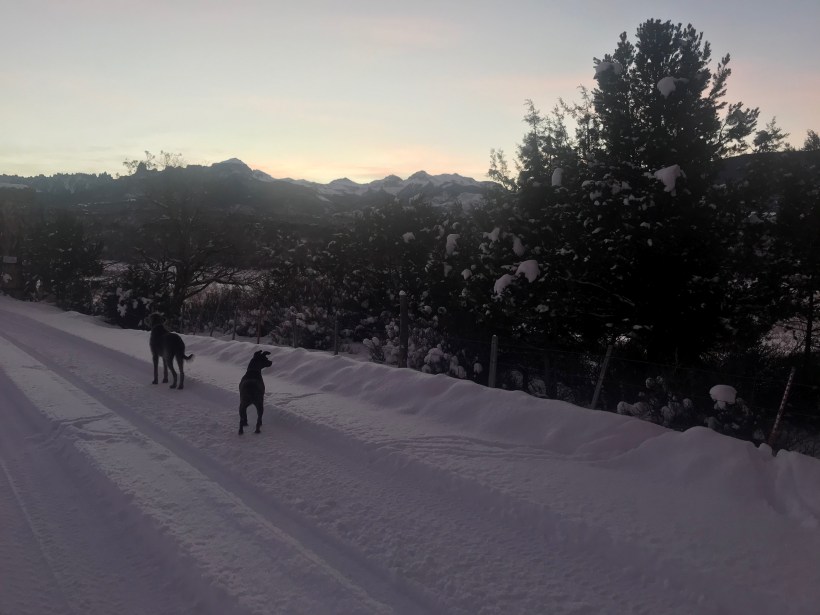
As I walked my dogs the other morning, I looked out onto a world made new. The crisp azure sky highlighted jagged mountain peaks covered in a dazzling fresh coat of snow. Cat Stevens’ song rang out in my mind, “Morning has broken, like the first morning. Blackbird has spoken like the first bird. Praise for the singing, praise for the morning….” Creation is continually sustained and remade, just as we are.


The new year and decade remind me that no matter where we’re at, whatever regrets we have or roads we may wish we had taken in the past, whatever has us feeling trapped or stuck, it’s always possible to find redemption for the areas in which we fall short and start over. As the great poet Rainer Maria Rilke prompted, “Let us believe in a long year that is given to us new, untouched, full of things that have never been.”


Leeana Tankersley writes about the prayer of St. Benedict used to call the saints of old to the holiness of repetition, “Always we begin again.” As an intention for each new year, day, or moment, it reminds us that all of life is about the openness for continual renewal. As Tankersley writes, “…that’s what so much of life is–learning how, and learning how again, over and over.”


Colombia has one of the oldest standing guerilla armies in the world and a long-standing internal conflict that has killed hundreds of thousands, affecting over nine million. Executive Jose Miguel Sokoloff and a group of peacemakers led their native country in transformation over several years during the holiday season.* Initially, they covered a path from the jungle where the guerillas hid with Christmas lights and left a message stating, “If Christmas can come to the jungle, you can come home. Demobilize. At Christmas, everything is possible.” The message worked and soldiers began to lay down their arms. The next year, Sokoloff’s group put bouncy balls that lit up into the rivers with personal messages inside from families who had soldiers fighting. Several soldiers a day returned home. Eventually, as many as 17,000 laid down their weapons. 
If this kind of societal transformation is possible, what is conceivable within our own individual stories? Will we allow the things that break our hearts to also crush our spirits? Will paths that fizzle out become dead ends or opportunities to forge a new road? Will each new day be a reminder of the time we’ve lost or of all that awaits? Emily Dickins exhorted, “The soul should always stand ajar, ready to welcome the ecstatic experience…DWELL IN POSSIBILITY.” If we are open-hearted and open-minded, willing to embrace a life that will consistently surprise us and a Creator that will continually transform us, the possibilities are endless. We can always begin again.

*(1) Lisa Shipley, “Christmas after Christmas: How a Colombian ad exec helped demobilize guerrillas by advertising peace,” The Bogota Post, December 3, 2017.

“Seeing New Lands, Losing Sight of the Shore…”

In college, I studied and trained to be a social studies educator, then found it difficult to find a position where I wanted to live in rural Colorado. Encountering this temporary career obstacle was one of the best things to ever happen to me. It prompted me to change my course and accept the invitation of a friend to teach English in the interior of the Dominican Republic. Without knowing more than a handful of words in Spanish, I left on a life-changing adventure. As Sheryl Sandberg says, “If you’re offered a seat on a rocket ship, don’t ask what seat. Just get on.” 


The time in the D.R. was simultaneously the most difficult and amazing experience of my life. Not only did I learn a new language, I gained the skills to navigate another culture and forge successful relationships within it. This rich season prompted a love of culture and travel that has shaped my adult years. When I returned to the States a year later, I became a Spanish teacher, a position that provided the opportunity to share this passion with countless students. My students and I often discussed the many benefits of travel..

1. OUR WORLD GROWS EVERMORE CONNECTED WITH EACH PASSING DAY.

The Twenty-First Century world we live in is more connected than at any other previous point in history. Technology, particularly the Internet and SmartPhones, has made this possible. In 1990, the distance between any two people, say strangers meeting in an international airport, was thought to be six people. Today, that distance is shortened to around three people (https://research.fb.com/blog/2016/02/three-and-a-half-degrees-of-separation/). The youth graduating in today’s world will compete for jobs with those from other nations. It is essential those nations are able to communicate with one another and have some level of understanding.

2. TRAVEL OPENS OUR EYES, EARS, AND HEARTS TO THE WORLD.

Through travel, we learn the skills to appreciate, understand, and build relationships with other cultures. Though speaking more than one language is important, even essential, it’s far more crucial that we each have the skills to appreciate, comprehend, and empathize with other value systems and ways of doing things. These skills are key to any type of relationship. 

2. ADVENTURE IS A STRETCHING AND REWARDING EXPERIENCE. 

The thrill of adventure can be uncomfortable, but also freeing. Through it, we are offered growth, learning, new perspectives and vistas, as well as fresh layers of comprehension and enlightenment. A former Harvard president once said, “Consider the turtle, “He doesn’t grow unless he sticks his neck out.” Growth always involves an element of risk, but it comes with infinite possibilities for reward as well. As André Gide once said, “In order to see new lands, one must consent to lose sight of the shore for a very long time.”

Framing through Attitude…

Many things are a matter of perspective. Our point of view often frames our experience, though life would have us believe we are victims of circumstance. Regardless of what we have suffered or the hands we have been dealt, we always have a choice over our attitudes.


In one of my all-time favorite quotes, author and pastor Charles Swindoll states:


“The longer I live, the more I realize the impact of attitude on life. Attitude, to me, is more important than facts. It is more important than the past, than education, than money, than circumstances, than failures, than successes, than what other people think or say or do. It is more important than appearance, giftedness or skill. It will make or break a company…a church….a home. The remarkable thing is we have a choice every day regarding the attitude we will embrace for that day. We cannot change our past…we cannot change the fact that people will act in a certain way. We cannot change the inevitable. The only thing we can do is play on the one string we have, and that is our attitude…I am convinced that life is 10% what happens to me and 90% how I react to it. And so it is with you…we are in charge of our attitudes.”


Kristene DiMarco of Bethel Worship has a song entitled, “I Am No Victim” in which she proclaims this:


“I am no victim, I live with a vision. I’m covered by the force of love, covered in my Savior’s blood.

I am no orphan, I’m not a poor man. The Kingdom’s now become my own, and with the King, I’ve found a home.”


Kristen continues by assuring us, “He’s not simple reviving, not simply restoring. Greater things have yet to come.”


How wonderful to believe that the best is yet to come. 


One of my favorite bands, The Head & The Heart, echoes this sentiment in their spellbinding song “Library Magic” with the hopeful cry:


“I can see the sunshine rays gleaming through the clear waters,

Telling me you gotta hop in for this chapter’s ride.

There will always be better days….”

“No Longer Slaves…”

In order to get a handle on right thinking, I know I must also confront and master the worry in my life. It’s been said that worrying is like sitting in a rocking chair–always moving but never getting anywhere. Though that certainly rings true of my own experiences, I find worry a hard habit to break.


The tasks of daily living, finances, health, relationships, and work are just a few of the themes that call for our attention and time. With every breath, I realize more how little control I have in life, yet I continue to fight for it. When confronted with my own powerlessness in any given situation, I want to at least be able to DO something, and worry seems to keep me busy and meet my anxious desire. 


In reality, however, I’ve been given much better options than worry. Meditation and prayer are powerful tools at my disposal for changing my own thinking and communing with the heart of God. Corrie Ten Boom, WWII concentration camp survivor and author of The Hiding Place, tells us, “Any concern too small to be turned upward into a prayer is too small to be made into a burden.” Whatever burdens our hearts, regardless of how minor or major, can be taken to the throne of God, to which we have free access through Jesus.


A dear friend of mine told me once that a counselor encouraged her to use a very practical tool to break the habits of worry and anxiety in her life. He suggested choosing a coat from her closet and labeling it as her “worry coat.” Any time she wanted to worry, she could, as long as she first put on the coat and wore it the entire time she fretted over things. As my friend followed her counselor’s advice, feeling ridiculous each time she wore the coat and eager to end the habit so that she could take it off, she gradually realized how much control she had over her thoughts. With a bit of discipline and a visual tool, she saw a tremendous decrease in her worry.


This discipline comes with one of the greatest promises in all of Scripture: “Be anxious in nothing, but in every situation, by prayer and petition, with thanksgiving, present your requests to God. And the peace of God, which transcends all understanding, will guard your hearts and minds in Christ Jesus” (Phillippians 4:6-7, NIV). It’s such a powerful visual to think of peace literally sitting watch and guarding the door of our hearts and minds! 


A song by Jonathan David & Melissa Helser of Bethel Music assures us we are “No Longer Slaves” of fear, but instead, children of God. The lyrics beautifully remind us to claim that identity:


You unravel me with a melody, You surround me with a song

Of deliverance, from my enemies, Till all my fears are gone.

I’m no longer a slave of fear–I am a child of God.


May peace that surpasses understanding guard each of our hearts and minds today. As Sarah Williams said, “I have loved the stars too fondly to be fearful of the night.”

“Thoughts of God…”-

Solomon tells us in Proverbs 23:7 that, “As a man thinks in his heart, so is he.” The apostle Paul encourages us in Philippians 4:8 to think on whatever things are true and just and lovely and honorable. With hundreds, even thousands, of thoughts entering our minds each and every hour, these verses are among the greatest challenges offered to us, yet also numbered in the most vital to our well-being.


How easy it is to allow our thinking to become negative or fixated on difficult circumstances–how natural to let unforgiveness or bitterness creep in! If our minds focus on such things, however, our hearts and speech overflow. As the modern saying goes, “What we focus on, grows.” I have been guilty of focusing on my own circumstances and pain recently–perhaps always, and I have seen the poor fruit resulting.


Words from an old friend call to me, “Genuine faith does not look at itself–it looks at God. When I feel in pain, the enemy is trying to get me to look at myself and look away from my Healer. When I feel insecure, then the enemy is trying to get me to look at myself and will remind me of my failings. So instead of trying to have more faith, I will try to look to Christ–remembering all His perfection, faithfulness, and goodness…. And I am in Him.”


Right thinking is one of the only sure foundations for living but it seems a monumental task. So how do I get there? As my friend encourages, I must focus on my Healer instead of the challenges at my doorstep or the ache in my heart or the pain in my body. I’m often reminded of King Jehosaphat’s story in II Chronicles 23–even when the circumstances are insurmountable, gratitude, praise, and prayer are always my way out. Author and researcher Brené Brown finds that the simple daily practice of keeping a gratitude journal is one of the biggest factors in cultivating the wholehearted attitude of gratitude. Spending time in God’s Word and in worship daily mold us into the image of Christ. The little things we do every day really do make a huge difference in our overall health and happiness.


Yet I know that if it’s up to me, my thinking and attitudes will change by small degrees–I’m dependent on the Holy Spirit for deep heart and life transformation. Missionary Amy Carmichael wrote a beautiful poem entitled “Thoughts of God” that begins, “Think through me thoughts of God/ My Father quiet me/ Till in Thy holy presence hushed, I think Thy thoughts with Thee.” He waits for me to surrender in order to be changed, to turn my eyes continually upon Him, but regardless, one thing can never change…I am in Him.

***Photo credits to lovedoes.org

“DO IT AGAIN…”

Though my family didn’t move to Colorado until I turned eight, having lived here thirty years this year, I consider myself very much a Colorado girl. Filled with more Fourteeners than any other state, Colorado’s high desert tundra, crystal mountain lakes, majestic sunrises and sunsets, alpenglow, and mystical mountains have “filled up my senses” countless times.


I’ve often wondered what it is about mountains that’s so captivating. They’re definitely a solid, seemingly immovable presence. They remind us there’s something and someone greater than us, greater than the obstacles we face each day. They invite and beckon to adventure, exploration, and challenge. They call us to see new beauty and summit the heights. And yet, as solid and unchanging as the mountains seem, Jesus tell us we can move them. “…Truly I tell you, if you have faith as small as a mustard seed, you can say to this mountain, ‘Move from here to there,’ and it will move. Nothing will be impossible for you” (Matthew 17:20, NIV).


There are a few seasons of life that have been marked journeys of faith for me, times when God called me to believe something that seemed virtually impossible at the time. It required a long wait, a lot of growth, and an attitude of expectancy as I navigated the valleys and summited the peaks. Sometimes, the hoped-for result came. Sometimes not. Most often, the answer looked quite different than I anticipated. But always, always, God proved Himself faithful, and the greatest reward came from His presence on the journey. In reality, it wasn’t my faith that moved mountains. My Father God worked on my behalf to move them for me as I depended on Him.


Several things have shifted in my circumstances lately, or burst, perhaps, is a better word. So now, here I am, once again in another season of absolute need, desperate for my God to move. As many times as God’s done the impossible and shown Himself strong in my life, still, it requires more faith for me to believe He’ll do it again. I continue to allow my fear to be bigger than my faith. But as song artist Rita Springer says, “I have to believe that He sees my darkness. I have to believe that He knows my pain…. For He said that He’s forever faithful. He said He’s forever true. He said He can move mountains. He can move my mountains; He can move your mountains too. I have to believe.” Faith simultaneously transforms us and sustains us. In Isaiah, hundreds of years before Jesus came, God assures us, “…I will not forget you. See, I have engraved you on the palms of my hands. Your walls…are ever before me” (Isaiah 49:16). What I face, He faces…He has engraved me on the palms of His hands. He has always been faithful…He will be again. “I believe Lord, help my unbelief” (Mark 9:24).


There’s a song by Elevation Worship that’s been speaking to my heart, “DO IT AGAIN.” The lyrics state:


“Walking around these walls

I thought by now they’d fall

But You have never failed me yet

Waiting for change to come

Knowing the battle’s won

For You have never failed me yet


Your promise still stands

Great is Your faithfulness, faithfulness

I’m still in Your hands

This is my confidence, You’ve never failed me yet


I know the night won’t last

Your Word will come to pass

My heart will sing Your praise again

Jesus, You’re still enough

Keep me within Your love

My heart will sing Your praise again


I’ve seen You move, come move the mountains

And I believe, I’ll see You do it again

You made a way, where there was no way

And I believe, I’ll see You do it again…”


Indeed. I have seen Him move mountains. And I do believe. I will see Him do it again. He has made a way where there was no way. Let’s believe we’ll see Him do it again.

Un Examen…

As a Spanish speaker, I’m very familiar with the term “un examen,” meaning an exam or test. Until recently, however, I was not familiar with the term “examen” as it was first practiced by the Ignatius of Loyola in the Fourteenth Century. The examen was a series of six questions the Jesuit priests used for reflection at the end of each day:


  • Where did I experience the most consolation today?
  • Where did I experience desolation?
  • What was the most life-giving encounter today?
  • What was not life-giving?
  • For what was I most grateful today?
  • For what was I least grateful?


I am struck by how deeply each of these questions resonates, but also by what a profound practice and ritual this is. In my own culture and life and time, it seems that I am always on the move. Like many, my to-do list is a mile long and I struggle to let go of many of the items on it each day, always pushing. In the end, I push because I feel good about myself when I have accomplished a lot, but is that truly a place of consolation, or one of desolation? A quote I read recently from Do Hyun Choe Sugi Master reflects the balance we all must find well: “Movement is what creates life. Stillness is what creates love. To be still and still moving…that is everything.”


So in this new year, as with every year, this is one of the intentions, “…to be still and still moving.” To do so, I must find a daily balance between joyfully completing the tasks that I must do, being with the people I love, and resting. First and foremost must come time to “Be still and know that [He] is God.” Carving out time for the type of reflection suggested by the examen would be a lovely conclusion. Max Lucado reminds us, “Next time a sunrise leaves you breathless or a sunset leaves you speechless, STOP…REMAIN THAT WAY. Say nothing as heaven whispers: ‘Do you like it? I did it just for you?’ “