“Invincible Summer in the Midst of Winter…”

Okay, so it’s late April and  officially spring, but in southwestern Colorado, it can be hard to tell in the month of April. Admittedly, we’re officially spoiled here–our state sees the sun shine an average of 360 days per year. This month, a couple hours a day is often all we get. The wind, cold, icy rain, and occasional snow give it the unmistakable feel of ongoing winter. With a global pandemic and the isolation of sheltering in place, it’s easy to let the doldrums of the season overcome. 

And yet, the red-winged blackbirds who arrived over a month ago sing their spring song and balance on the thinnest of branches regardless of the storms. They remind me of the thoughts of great thinkers of long ago. Albert Camus wrote, “In the midst of winter, I finally discovered that deep within me lies an invincible summer.” Transcendentalist Henry David Thoreau encouraged, “Live each season as it passes; breathe the air, drink the drink, taste the fruit, and resign yourself to the influence of each.” What lovely reminders that wherever we’re at, there are pleasures and beauty to be found and enjoyed, moment by moment. Summer can always be cultivated within us.

In my own winter mentality moments, I continue to grieve for the loss of a career I loved due to poor health. Although it’s been a couple of years since I quit teaching full-time, I struggle to find my place in the professional world. For the second year in a row, I applied for a job I hoped might be the solution and didn’t get it. As I lamented to a friend the difficulty of no longer being valued or known in this professional realm, she reminded me of the TRUTH. I am absolutely valued and known, seen and heard. My God has not forgotten me and will walk with me through this season. Psalm 18:19 assures me He brings me out into a place of abundance because He delights in me.

 
In Lamentations, the prophet Jeremiah, writing in a time of great personal and societal suffering, said, “Because of the Lord’s great love we are not consumed, for His compassions never fail. They are new every morning; Great is Your faithfulness (Lam. 3:22-23, NIV). Brother Lawrence, a saint of old, saw all men like trees in winter, stripped of color, leaf, and anything of value–yet loved unconditionally. Though I am a humble tree in winter, struggling toward warmth and light, I will “…live this season as it passes…” knowing “…within me lies an invincible summer.”

“Welcome It All…”

Uncertainty clouds these present days…times unprecedented for many generations. Few of us could have foreseen our entire nation on high alert due to a dangerous new pandemic virus. The citizens of many states have orders to shelter in place, everything from schools to salons to government offices are shut down, and the majority of those who still have employment work from home. It’s easy to see that if nothing else, the economic ripples will be far-reaching. In all likelihood, far more will be affected.

It’s no wonder why the natural response of many is to panic. Reactions range from everything like hoarding toilet paper and Tylenol to becoming agoraphobic. Though I’m feeling increased anxiety these days, I’m also continually reminded, more than anything else, to breathe. Author Brené Brown says that according to her research, the majority of those who live wholeheartedly are “obnoxious breathers.” Though stated comically, I believe it’s true. Regulating our nervous systems often takes so much intentionality that it can come across that way. But the more we can keep ourselves from reacting emotionally, even naturally, in difficult situations by stopping to take a few deep breaths, the better chance we have of responding with equanimity.


In the first episode of her new podcast, “Unlocking Us,” Brené also discusses that when transitioning into difficult new seasons, experienced adults know that as hard as it is, the only way to get to the other side is to push through. As we do this, however, it’s crucial we take the time to name the difficulty of what we’re doing. Only then can we get to the place where we can embrace where we’re at without burying resentment and frustration.


For example, while sheltering in place and working from home, screens seem to await me at every turn. Work requires being on my computer eight hours a day, something my spine finds very difficult. Everything from church to medical visit to most shopping now come online. Connecting socially most often means texting, phoning, or Facebooking. Although I initially felt grateful to have these opportunities, I must admit, I’m finding tele-connecting difficult and far from authentic. 


But on a cool windy day this week, it dawned on me that spring arrived with the equinox earlier this week. The birds arrived weeks ago, baby calves play on a neighboring field, and neither seems to realize we’re in the midst of a pandemic. On a whim, I grabbed my gardening gloves, a spad, a bag of potting soil, and a few plants that needed repotting. We all went out into the sun embracing it along with the bitter wind. I closed my eyes and decided, as Father Thomas Keating once wrote, I would, “Welcome It All:”

“Welcome, welcome, welcome [it all]…I welcome everything that comes my way today because I know it’s for my healing….I let go of my desire to change any situation, condition, person, or myself. I open to the love and presence of God and God’s action within it.”


For an hour or so, I immersed my hands in earthy soil and attempted to give the beautiful living plants I’ve been given more space to stretch their roots and GROW. ITs was a wonderful reminder of BEAUTY and LIFE, a gentle nudge to get off all the screens as much as I can and nurture the things that provide me with sustenance and rest. I love Eugene Peterson’s translation of Matthew 11:28-30 in The Message: “Are you tired? Worn out? Burned out on religion? Come to me. Get away with me and you’ll recover your life. I’ll show you how to take a real rest. Walk with me and work with me—watch how I do it. Learn the unforced rhythms of grace. I won’t lay anything heavy or ill-fitting on you. Keep company with me and you’ll learn to live freely and lightly.”


Jill also sings this invitation in her song, “I AM:” 


“The tide can change so fast, but I will stay the same through past, the same in future, the same today

I am constant, I am near, I am peace that shatters all your secret fears…

Oh weary, tired, and worn, let out your sighs, and drop that heavy load you hold, ’cause mine is light.”

“Your Love Awakens Me…”

I’ve noticed that when I can’t be still, when my OCD tendencies kick in and I’m operating on overdrive when I’m spinning in circles in a wild attempt to fix everything, that I need to stop and pay attention. Something is going on under the surface. Instead of numbing through activity and efforts to keep things under the illusion of control, I must be willing to sit with the discomfort. And this…this is hard.


As author, researcher, and speaker Brené Brown says, we all have ways of numbing. For some, they come in the more blatant form of substance addiction. For most of us, it’s subtler. We escape the pain of conflict, life, or difficult seasons or relationships with Facebook, food, television, or shopping…even cleaning. Not that any of these things are bad. They are all necessary and good in moderation. But the question is…are they bringing us pleasure and rest, or are they deadening our senses so that we feel we can cope?


Although I often retreat to unhealthy spots, God continually calls me out of these places, reminding me, “Come out of hiding, you’re safe here with me…You’ve been on lockdown and I hold the key…..(Steffany Gretzinger & Amanda Cook, Bethel Worship)” He is perpetually opening my eyes to the world around me, helping me learn that it’s connection, not escape, which helps me survive. Brené Brown also states that letting go of numbing and powerlessness is one of the ways we cultivate a resilient spirit and embrace wholehearted living.


This reminds me of what the great poet Rumi said, “Your task is not to seek for love, but to see and find all the barriers within yourself that you have built against it.” It also brings to mind a recent worship song, by Phil Wickham, but also sung by McKenna Sabin, “Your Love Awakens Me,” which states:


“There were walls between us,

By the cross you came and broke them down…

You called me out of the grave. You called me into the light.

You called my name and then my heart came alive.

Your love is greater. Your love is stronger.

Your love awakens, awakens, awakens me.”


It’s a continual process, but I ask that this day, moment by moment, I can allow His love to lead me out of the darkness and into the light, to break every chain, to awaken me. As poet e.e. cummings once wrote,


“I who have died am alive again today…

now the ears of my ears awake and

now the eyes of my eyes are opened.”

“No Longer Slaves…”

In order to get a handle on right thinking, I know I must also confront and master the worry in my life. It’s been said that worrying is like sitting in a rocking chair–always moving but never getting anywhere. Though that certainly rings true of my own experiences, I find worry a hard habit to break.


The tasks of daily living, finances, health, relationships, and work are just a few of the themes that call for our attention and time. With every breath, I realize more how little control I have in life, yet I continue to fight for it. When confronted with my own powerlessness in any given situation, I want to at least be able to DO something, and worry seems to keep me busy and meet my anxious desire. 


In reality, however, I’ve been given much better options than worry. Meditation and prayer are powerful tools at my disposal for changing my own thinking and communing with the heart of God. Corrie Ten Boom, WWII concentration camp survivor and author of The Hiding Place, tells us, “Any concern too small to be turned upward into a prayer is too small to be made into a burden.” Whatever burdens our hearts, regardless of how minor or major, can be taken to the throne of God, to which we have free access through Jesus.


A dear friend of mine told me once that a counselor encouraged her to use a very practical tool to break the habits of worry and anxiety in her life. He suggested choosing a coat from her closet and labeling it as her “worry coat.” Any time she wanted to worry, she could, as long as she first put on the coat and wore it the entire time she fretted over things. As my friend followed her counselor’s advice, feeling ridiculous each time she wore the coat and eager to end the habit so that she could take it off, she gradually realized how much control she had over her thoughts. With a bit of discipline and a visual tool, she saw a tremendous decrease in her worry.


This discipline comes with one of the greatest promises in all of Scripture: “Be anxious in nothing, but in every situation, by prayer and petition, with thanksgiving, present your requests to God. And the peace of God, which transcends all understanding, will guard your hearts and minds in Christ Jesus” (Phillippians 4:6-7, NIV). It’s such a powerful visual to think of peace literally sitting watch and guarding the door of our hearts and minds! 


A song by Jonathan David & Melissa Helser of Bethel Music assures us we are “No Longer Slaves” of fear, but instead, children of God. The lyrics beautifully remind us to claim that identity:


You unravel me with a melody, You surround me with a song

Of deliverance, from my enemies, Till all my fears are gone.

I’m no longer a slave of fear–I am a child of God.


May peace that surpasses understanding guard each of our hearts and minds today. As Sarah Williams said, “I have loved the stars too fondly to be fearful of the night.”

Un Examen…

As a Spanish speaker, I’m very familiar with the term “un examen,” meaning an exam or test. Until recently, however, I was not familiar with the term “examen” as it was first practiced by the Ignatius of Loyola in the Fourteenth Century. The examen was a series of six questions the Jesuit priests used for reflection at the end of each day:


  • Where did I experience the most consolation today?
  • Where did I experience desolation?
  • What was the most life-giving encounter today?
  • What was not life-giving?
  • For what was I most grateful today?
  • For what was I least grateful?


I am struck by how deeply each of these questions resonates, but also by what a profound practice and ritual this is. In my own culture and life and time, it seems that I am always on the move. Like many, my to-do list is a mile long and I struggle to let go of many of the items on it each day, always pushing. In the end, I push because I feel good about myself when I have accomplished a lot, but is that truly a place of consolation, or one of desolation? A quote I read recently from Do Hyun Choe Sugi Master reflects the balance we all must find well: “Movement is what creates life. Stillness is what creates love. To be still and still moving…that is everything.”


So in this new year, as with every year, this is one of the intentions, “…to be still and still moving.” To do so, I must find a daily balance between joyfully completing the tasks that I must do, being with the people I love, and resting. First and foremost must come time to “Be still and know that [He] is God.” Carving out time for the type of reflection suggested by the examen would be a lovely conclusion. Max Lucado reminds us, “Next time a sunrise leaves you breathless or a sunset leaves you speechless, STOP…REMAIN THAT WAY. Say nothing as heaven whispers: ‘Do you like it? I did it just for you?’ “

“There Is No There, There” (Shauna Niequist)-

The besetting sin in my life would definitely be perfectionism. I’m task-oriented, uber-organized, a performer, a big fan of structure, routine and predictability. I like my spaces, relationships, and life neat and tidy. So many things in the past have spun out of control. Somewhere along the line, I learned to cope by controlling the things I could in my physical environment or at least attempting to do so.


But control is always an illusion. Life rarely fits into neat and tidy compartments.  I’m learning, of course, but it’s such a struggle for me to let go. When I can do just that, when I can stay in the moment, each one is a gift. I love what Abraham Lincoln said: “Yesterday’s history, tomorrow’s a mystery, today is a gift…that’s why they call it the present.”


Shauna Niequist has an excellent study entitled Present Over Perfect. That, my friends, is the goal: I want to learn to be present where I’m called to be, in each real moment, not continuously striving for an elusive quality of perfection that might even be termed destructive. There’s a phrase I learned through that study that often comes to mind when I find myself in one of those manic obsessive-compulsive drives: “There is no there, there.” North-American culture, as well as many others, can be so performance and appearance oriented. It’s as if we’re all striving to reach a perfect place where we will someday arrive, to find a euphoric Zen state to dwell in. But does it exist this side of heaven?

 
Shauna also talks about learning to flee a life where she was frantically searching for a diamond necklace, when all the time, it hung around her neck. Aren’t we all…just…searching? “There is no there, there.” A diamond necklace DOES grace each one of our necks. It was placed there by our Father God. His Presence perfects us, makes our present moments all they should be. The only way to be present over perfect is to accept that in His perfection, He made us totally right, made everything alright. He accepted us as we are, made us His own, and gave us all we need. May we each find the grace to receive the gifts we’ve been given, to open our arms and receive the provision that perfects our present.

The Magic of Ordinary Days…

At last, my husband and I have entered a season of normalcy, a time of settling…at last. For him, it involves the beginning of a new job and the ascent of a high learning curve. For me, it is a return to the familiar, finding once more the cadence of a place my heart knows and loves. The rituals of living consume a good portion of the day, but as I clean, work or study, prepare meals, exercise or walk the dogs, I find in each ordinary task an extraordinary richness. After being away from all this for several months, my eyes are opened to the magic and gift of this life. The consistent, quiet routine nourishes my soul.


In her blog entitled, “When You Need a Survival Guide for the Soul,” author Ann Voskamp writes, “Habits are the way we wear our days…. Habits are the small gears that leverage your life–and if you change your rhythms, you can change anything into a possibility. You change your life when you change how you meet Christ every day. Our rhythms become our everyday liturgy, the cadence of the hours that reorient our tired souls.”


After almost four decades, I am learning little habits that help me to enjoy life a bit more. I try to do one thing at a time. I take a deep breath and look around when I eat a meal. I drink a cold glass of ice water and listen to music as I cook. I stop what I’m doing to be fully present when someone walks in the room. I read more and watch television less. I smile when I walk. Late in her life, Laura Ingalls Wilder wrote, “I am beginning to learn that it is the sweet, simple things of life which are the real ones after all.”

 
Ann Voskamp continues, “Musicians play one right note after the next right note after the next right note. It’s not an erratic splattering of sound or a fickle, helter-skelter banging of random notes. Music has order. It is composed. The notes played are intentional, considered, and deliberate. Lives that have rhythm sing. They don’t survive — they thrive…. Consistently keep the same soul rhythms every day, and you grow deeper into Him, the One who will reweave your soul into glory.” As we play each simple note, one after another, may the melody bring peace to others, and to our own souls…may it inspire us to thrive in each ordinary day.  

A Spacious Place…

Just now I’m listening to the song of wind chimes blowing in a gentle summer breeze outside my window. Curtains rustle as the light filters in. The dogs sleep in a mix of sun and shade under a tree where apples ripen in preparation for the autumn harvest. I sit at the table with the extraordinary gift before me of a peaceful, quiet time in which to read and reflect and write. As friends begin teaching children for a new school year, a blessing we once shared, I have a whiff of nostalgia, but breath a deep sigh of relief, for I know it had become too much for my fragile body.


A man walks his clomping horse up the dirt road where we live in this one-of-a-kind small mountain town. Though late August, the tundra on the hills has begun to change and the evenings are cooler. I settle into the weekday morning quiet of this world and feel deep gratitude for the season of rest I’ve been granted in this beautiful and spacious place. Studies completed, new paths opened and explored, more adventures and learning await and good work will need to be done. But for now, this day, I rest and give thanks.


Many times this was among the things only hoped for and imagined. That being said, it is important that I remember: my Father God and loving friends generously sacrificed and gave to share this with me. Both have been oh so sweet and faithful. As Psalm 18:16-19 proclaims, “He reached down from on high and took hold of me; He drew me out of deep waters. He rescued me from my powerful enemy, from my foes, who were too strong for me. They confronted me in the day of my disaster, but the LORD was my support. He brought me out into a spacious place; He rescued me because He delighted in me.”
As author Ann Voskamp states, the act of remembering re-members us, helping rejoin the broken pieces. A dear friend reminded me today: there have been miracles…. there will be miracles. It’s good to remember. The chimes sound as the winds stir a song of praise.  

Strong Hands, New Eyes…

Oscar Wilde once said, “It takes great courage to see the world in all its tainted glory, and still to love it.” This truth often strikes me, for, on a daily basis, I am amazed by the beauty and kindness and inspirational perseverance around me. On an equally frequent level, I am confronted with woundedness, ugliness, and hypocrisy. To hold the tension of this world’s  “tainted glory” well takes great balance and skill. Whatever and whoever there may be in my own path, I am quick to judge, to praise or condemn, to choose a personal response that has the potential to fall on either end of the spectrum.


Whether in line at the post office or the supermarket, driving, walking in the beautiful mountain town where I live, or working, I cross paths with many I choose to ignore. How many do I encounter every day who are longing to be seen or heard or helped in some way? Most often, I choose to believe that my schedule is too busy, my hands are too small and weak. I allow my eyes to cloud over and my mind to wander back to its self-preoccupation.


But what if my small hands are strong enough to offer a drink to the thirsty? What if doing so is the water my own soul needs? As David Foster Wallace says in his graduation speech entitled “This Is Water,” “Sometimes the hardest and most important realities are often the hardest to talk about.” In the petty frustrations of day-to-day living with narrow-sighted vision, it is only in choosing to look around with compassion that we find our own paths enlarged.


Just as  Jesus did, we are called, “…to preach good news to the poor…to bind up the brokenhearted…to proclaim freedom for the captives and release from darkness for the prisoners, to proclaim the year of the Lord’s favor…to comfort all who mourn, and provide for those who grieve…to bestow on them a crown of beauty instead of ashes, the oil of gladness instead of mourning, and a garment of praise instead of a spirit of despair” (Isaiah 61:1b-3a). God says that “…if you spend yourselves in behalf of the hungry and satisfy the needs of the oppressed, then your light will rise in the darkness, and your night will become like the noonday” (Isaiah 58:10).


Spanish-speaking artists Marcela Gándara and Jesus Adrian Romero have a beautiful song entitled “Dame Tus Ojos” (“Give Me Your Eyes”). In the song, they ask God, “Give me your eyes I want to see. Give me your words, I want to speak.” The song is a petition to be filled with the Spirit of God in every step. As we become Christ’s body and His church, may we literally be His hands and feet, see with His eyes, love with His heart.

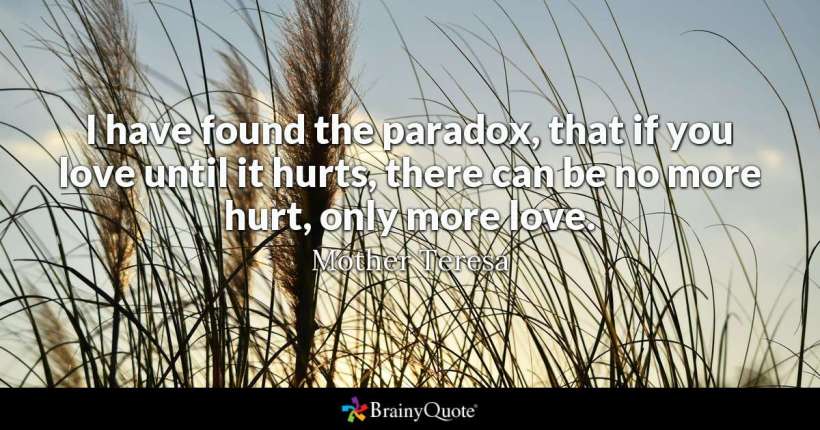
***Photo Credits: Brainy Quote

Cracks…

There really isn’t a time in my life when I don’t remember actively walking with the Lord, so one would think that as I begin my thirty-seventh year, I would pretty much have this walk down. Wrong. There are so many days when I feel distant from my Father, so many times when I clearly see my sin and flaws realized in bad behavior. This worn vessel cracks and leaks in ways that make it appear less than ideal for useful service. I hurt those I love most and fall short of God’s glory and my own ambitions every day. At times I am the judgemental older brother, at others, I know myself to be as the wandering and rebellious prodigal son.


As RZIM A Slice of Infinity author Jill Carattini pointed out, there’s an easily glanced over phrase in the prodigal son story, “…the prodigal ‘came to himself’ and, at this, he decides to turn back to the father…. The son is one who wakes to health and life again, having been unconscious of his true condition. Standing in a foreign field hungry and alone, the son comes to something more than a good decision. He is waking to an identity he knew in part but never fully realized. He is remembering life in his father’s house again, though for the first time.”


How easy it is to lose sight of our identity when we wander away from our Father’s house. How easy it is to forget who God says I am. Lauren Daigle’s recent song, “You Say” beautifully affirms that He sees me cleansed, perfected, and redeemed. He provides acceptance and belonging. No matter what condition I’m in, I can always turn back to the open and waiting arms of my loving Father God.


This vessel may be cracked, but may it come to itself, may it come home, and may it be of use. As the apostle Paul said in II Corinthians 5:7-9, “7 But we have this treasure in jars of clay to show that this all-surpassing power is from God and not from us. 8 We are hard pressed on every side, but not crushed; perplexed, but not in despair; 9 persecuted, but not abandoned; struck down, but not destroyed.”


Canadian poet and songwriter Leonard Cohen also summed it up well in his song “Anthem,”:
“Ring the bells that still can ring
Forget your perfect offering
There is a crack, a crack in everything
That’s how the light gets in.”