“Prepare to Be Surprised”…

In the movie Dan In Real Life, Dan is a dad considering what to say to his daughter as she graduates from high school & heads out into the world. As he does so, he starts to examine his own life, & how often it surprised him, or failed to meet any of his expectations.  So, why is it that we’re always asking graduates what their “plans” are? Why do we try so hard to prepare for what’s coming, when in reality, we know there is no adequate preparation? Whatever happens will probably come as pretty much…a total surprise.  While plans & dreams can be great things, our expectations of what we think our lives are supposed to look like so often constrain & disappoint us. We often hold these visions so firmly, & cling so tightly, that it makes it difficult for our hands to be open to other great things God has intended for us.


Corrie Ten Boom, survivor of the Holocaust & author of The Hiding Place, said it this way: “I’ve learned to hold things loosely.  I don’t like it when He has to pry them from my grip.”  Living a surrendered life is not easy, but it IS what God call us to do, & it must be done over & over again.  In his Superpower Poem, Steve Gross states: “Openness to what is can take us far. Suffering is rooted in wanting things to be different than the way they are.”  How true this is, & how grand it would be if we could live each day as small children: open to whatever the day brings, playful & joyful in the opportunities that come, ready for adventure…all simply because they’re trusting in the good things they know their parents have prepared. “It isn’t that I cling to Him, or struggle to be blessed. He simply takes my hand in His, & there I let it rest. So I dread not any pathway, dare to sail on any sea, since the handclasp of my savior makes the journey safe for me” (unknown). It’s safe, we can trust Him…so let’s consider willingly surrendering our expectations to our Lord, & live prepared…to be surprised.

“Better Is One Day In Your Courts”…

I live in the most beautiful place, in a small town on the western slope of Colorado, at the foot of incredible mountain ranges. Each morning the sun rises in a perfectly azure Colorado sky; each evening, it sets, casting all hues of glory on the tips of the peaks. The shifting of light and shadows on the surrounding hills often overwhelms my senses. In the winter, each summit is capped by the whitest snow, causing bare trees to hang heavy in sparkling filigree; in the summer, inconceivable varieties of wildflowers paint brand new wheels of bold color with each thousand feet of elevation. In the spring, the bright green of the budding trees in the forests takes my breath away; each autumn, their floors, and the mountains in which they dwell, are carpeted by golden aspen leaves and bronzed tundra. The vistas are stunning, the wanderings within their nooks and crannies always seem to hold new revelations for me.


I’m so lucky to have lived almost half my life in this incredible region. Every day, I count myself blessed with life and breath and movement, and the gift to live here in this wondrous, lovely place. If I remain here all my days, and spend them exploring the vast ranges and expanses of wilderness, there will still be more that remains unseen. My days have been graced with a quality of life many others desire; I’m filled with gratitude to be able to call it home, to rest here in this place.


Though this compelling beauty captivates me daily, it’s just one small corner of earth, just a barely visible dot within our solar system. Yet this place has nothing compared to the courts of God. In Psalm 84:10, the psalmist says “How lovely is your dwelling place, O LORD Almighty. Better is one day in your courts, than a thousand elsewhere.” We are all invited to dwell there in that glorious place, making our home with Him, for all eternity. We are all invited there now, today, to enter into the fullness of His abiding presence.

“The Wonder of It All”…

A dear friend once gave me a card that said “Never lose your sense of wonder.” Coming from her, this encouragement carries great weight for me; it becomes an inspiration because it reflects a life grounded in both reality and wonder. Though nearing retirement and a veteran of more than her fair share of life’s challenges, she’s never lost her curiosity and amazement with life and the Lord. I came to know her as my mentor and friend when I moved to the town where I began my first long-term teaching job. She taught high school, and helped me learn to do the same. Her contagious vivacity and wit, as well as natural way of connecting and empathizing with youth, make people assume she’s twenty years younger than she actually is. She always downplays her own role in this, claiming that teaching keeps us young. Indeed, I have found this to be true, but most especially so when we as teachers are willing to be affected by all those we teach. She’s ever-willing, and because she is, her life in turn, has profoundly affected those of the students she taught.
Though we no longer teach together, I still consider her my mentor. As a teacher and a person, she is a force as awesome and resilient as nature herself. There are powerful influences in her life that have often attempted to determine and shape her reality, but she has staunchly refused to acquiesce.  Though at times her circumstances have seemed challenging, she faithfully cultivates joy one day at a time, continuously searches for reasons to laugh, walks determinedly in faith and not by sight, and pursues connections that pull her into spheres of positivity. I’ve known her almost ten years now, and in that time, she’s adopted me, welcoming me into her home and family as if I were a second daughter. When I became sick with a chronic illness, she cared for me. She has seen and understood me at the times where it seemed like few others could. She has refused to let me give up or give in to negativity, most effectively by her own example. Edith Wharton, the first woman to win the Pulitzer Prize for Literature, once said something that seems to purposefully describe my friend: “One can remain alive  long past the usual date of expiration, if one is unafraid of change, happy in small ways, insatiable in intellectual curiosity, and interested in big things.” My wonderful friend has lived in such a way, and therefore, remains not just alive, but ALIVE.  In other words, my friend lives out God’s granting of another’s request: “I do not ask to know the reason for it all; I ask only, to know the wonder of it all” (Heschel, Abraham). May we all be continually captivated by the wonder of it all.

Standing on the Promises…

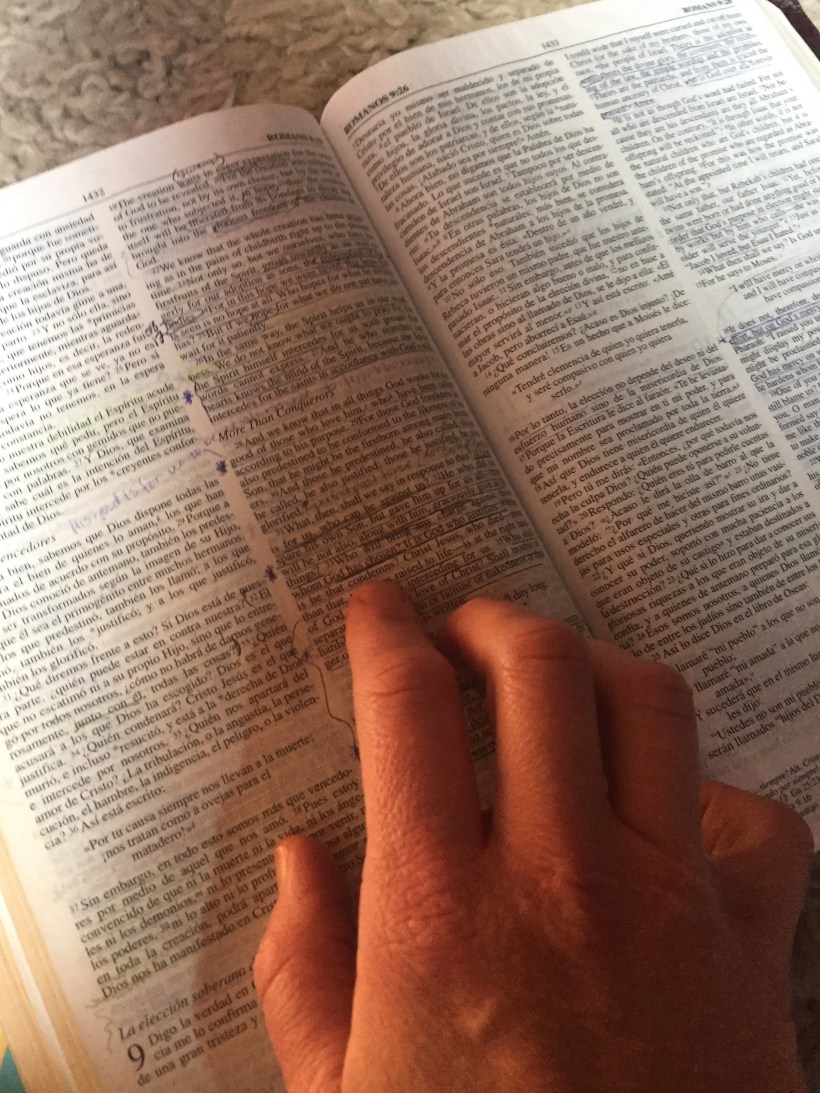
I’ve said this liturgy of promises to myself over & over again, most often in times of great anxiety or distress. Almost fifteen years ago, in such a time, God reminded me that I could rest assured in any situation by claiming His Word. Psalm 94:19 says: “When anxiety was great within me, your consolation, O LORD, brought joy to my soul”. As I poured out my heart to Him that evening, it was as if He began to assure me of the unfailing promises I could always hold. I found myself listing them off on my fingers, finishing with exactly enough for two full handfuls. I call them my “Finger Promises”:


    1. God is w/ me, & will always be with me. (Isaiah 41:10, 43:2; Zephaniah 3:17)
    2. God loves me, & will always love me. (Psalm 136, Jeremiah 31:3, Romans 8:35-38)
    3. God is at work in my life, & He will always be at work in my life. (Psalm 121:7, Philippians 1:4, II Corinthians 2:14)
    4. God is in control, & I am not, for He is God, & I am not. (Psalm 135:6, Romans 8:27)
    5. No matter how circumstances appear, He is always at work for my good & His glory. (Isaiah 48:9, Romans 8:28-32, II Corinthians 9:8)
    6. He desires to give me the desires of my heart. (Psalm 16:11, Psalm 37:4)
    7. He has plans to prosper me, & not to harm me, to give me a future & a hope. (Jer. 29:11, Lamentations 3:31-33)
    8. God will not allow me to be tempted beyond what I can bear, & always lends me His strength. (I Corinthians 10:13, II Corinthians 12:9)
    9. The Lord’s timing & plan for my life are perfect. (Psalm 138:8, Isaiah 46:10)
    10. His love for me is perfect. (Isaiah 49:15-16, Romans 8:32, Galatians 4:7, I John 3:1,16)

 
The mere fact that I’ve never struggled to remember this list, and that each promise seems as clear to me now as it was the night they were given, seems to me a sign that God Himself wrote them on my heart. As I’ve searched the Scripture since, I’ve found multiple verses to support every single one. They assure my heart in each and every situation I face. No matter what, I’ll be okay. He hasn’t forgotten me, He never will. His love will always sustain me. His hand will never stop shaping my life to His purposes. Because of these promises I can stand and say with confidence: “I am not afraid of storms, for I am learning to sail my ship” (Louisa May Alcott). Let us continually take His promises up in our hands and hold them close, let us stand upon them as a sure foundation. He is always enough to satisfy our souls and fill our lives to overflowing.

Irony of Christianity…

In the movie Becoming Jane, the character of Jane Austen offers a wonderful definition of irony: “…the bringing together of two contradictory truths, but always done with a smile”. As an author, Austen is most praised for her astute observations and understanding of human character. The ability to understand the complexity of human nature must take irony into account. It is an incontestable component of life. We all have some  experience with navigating its paradoxes. Those of us who find happiness have learned to do it with a smile.

 
This definition of irony calls to mind many things for me, but foremost among them is Christianity. We are saved sinners; we’ve been made right with God, but live out our sanctification; God’s power is made perfect in our weakness (II Corinthians 12:9); we walk in faith, and yet by sight. The season of Advent is described as “the already, and the not yet”. Jesus, our Messiah, lived a life where He was fully human, yet fully divine. The apostle Paul described the irony of the Christian life in his second letter to the young Corinthian church: “…we are hard-pressed on every side, but not crushed, perplexed, but don’t despair; persecuted, but not abandoned; struck down, but not destroyed….having nothing, and yet, possessing everything” (II Corinthians 4:8-10). Paul cuts to the core of the irony of Christianity in that same letter: “We have this treasure in jars of clay to show that this all surpassing power is from God, and not from us….Therefore we do not lose heart: Though outwards we are wasting away, yet inwardly we are being renewed day by day” (II Corinthians 4:7, 16). The irony of Christianity is a God who continually offers Himself to fill the needs of humanity, through broken humanity itself.

Tenderness…

 Anyone who listens to a music playlist of mine comments that I must be a “hopeless romantic”. Those who know me best would say that’s true, but in a different way than it might first appear. I never thought that mine would be a temperament satisfied with anything less than a tangible romantic love, but here I am, thirty-five and still single, and content. It’s only by the grace of God I can call myself a hopeFUL romantic. Since high school, I’ve prayed that God would turn all of the desires of that naturally hopeless romantic heart towards Him. He has answered my prayer, as He always does. When I hear a love song now, most often, my first thoughts are of Him. A great favorite is the song “Love Me, Tender”.


Though the word tenderness seems to have gone out of style with Elvis, it’s a wonderful word, and so perfect a description of the character of our Lord. Its synonyms include: kindness, kindliness, kindheartedness, tenderheartedness, compassion, care, concern, sympathy, humanity, warmth, fatherliness, motherliness, gentleness, benevolence, generosity. In Lamentations 3, the prophet Jeremiah states that the “tender mercies of the Lord” are new every morning. His is the only love that is merciful in every capacity, gentle in its every dealing, compassionate in its every gaze. The words of the song capture His unfailing love, the Love that can fulfill all our dreams, and take us into its heart, filling us with everlasting joy:


Love me tender, love me sweet, never let me go,

You have made my life complete and I love you so.

Love me tender, love me sweet, all my dreams fulfilled,

For my darling, I love you and I always will.

Love me tender, love me long, take me to your heart.

For it’s there that I belong and we’ll never part.

Love me tender, love me sweet, all my dreams fulfilled,

For my darling, I love you and I always will.

Love me tender, love me dear, tell me you are mine,

I’ll be yours through all the years till the end of time.

Love me tender, love me sweet, all my dreams fulfilled,

For my darling, I love you and I always will.

The Inevitability of Hope: Esperanza…

In her beautiful novel Gilead, Marilynne Robinson’s protagonist astutely notes, “We are never out of light, we just turn around in it.” David said it too in the 139th Psalm:


“Where can I go from your spirit, where can I flee from your presence? If I go up to the heavens, you are there. If I make my bed in the depth, you are there. If I rise on the wings of the dawn, if I settle on the far side of the sea, even there your hand will guide me, your right hand will hold me fast. If I say, ‘Surely the darkness will hide me, and the light become night around me’, even the darkness will not be dark to you, the night will shine as the day, for darkness is as light to you.”


Such statements would seem to describe our existence on earth. We cannot escape the light and love and presence of God, and yet we dwell in the valley of the shadow, where we cannot yet fully enter in. Though I cannot escape His love, I am also unable to avoid waiting for its full realization. To be able to enter fully into the presence of peace one day is our hope; hope is essential to life. I remember feeling caught off guard once as I read Paul’s observations on hope in Romans 5:3-5:


Not only so, but we also glory in our sufferings, because suffering produces perseverance, and perseverance, character, and character, hope; and hope does not disappoint us, because God has filled us with His love by the power of His Holy Spirit.”


I was in my early 20’s, and processing several years of experiences that had been traumatic for various reasons. The passage struck me because I felt jaded, and in my cynicism, had begun to assume hope could only be the product of naivité, something generally found at the outset of experience, but not at its end. This verse asserts the opposite: Hope comes as the fruit of suffering, perseverance and character; if hope is founded on the true love of God, it cannot lead to disappointment. As Paul says later in Romans, the eighth chapter, “Nothing can separate us from the love of God.”
It encourages me to think that though there are times I might not always feel hopeful, I can trust that it is still a possibility of whatever process I am in. In Spanish, the verb for “to hope” is the exact same as both the verbs for “to wait” and “to expect”. Though in English, the terms are nuanced, when viewed as they are understood in Spanish, it seems true we cannot separate them. “Who hopes for what he already sees? But if we hope for what we cannot see, we wait for it patiently” (Romans 8:25). Paul also felt the terms and their practices were inseparable. Esperanza: hope and expectation, inextricably intertwined. If waiting is unavoidable, perhaps too, expecting and hoping are inevitable: “We are never out of light, we just turn around in it.”

“Looking for An Answer to a Question I Can’t Name”

I learned a long time ago to stop asking questions of others if I don’t want to hear their answers. At least that’s the case most of the time, with most people. It’s definitely a different story when it comes to God; despite my best efforts to predict and control my circumstances, He always seems to answer in the most unexpected ways. Sometimes His responses takes my breath away with how wondrous they are; others, they can stop me in my tracks with how much they seem to wound. He’s hard for us all to comprehend. Mostly, it seems my questions have to do with the problem of pain, essentially asking why I and others must suffer. Christian apologist Ravi Zacharias points out that only a Western worldview would allow this question. Isn’t it funny that we frequently question why we deserve to suffer, but rarely consider why a just God has freely given us so much love and grace and beauty?


Just maybe, I’m trying to reconcile the irreconcilable. Still, I can’t seem to stop wondering why things happen as they do. Why are we all living our lives as if we’re trying to tip the scales in our favor, when we have to know that’s not the way it works? Maybe, as Norah Jones sang, “I’m looking for an answer to a question I can’t name”. Author Marilynne Robinson reflects on this too:


“Things happen for reasons that are hidden from us, utterly hidden for as long as we think they must proceed from what has come before, our guilt or our deserving, rather than coming to us from a future that God in his freedom offers to us… My meaning here is that you really can’t account for what happens by what has happened in the past, as you understand it anyway, which may be very different from the past itself. If there is such a thing….Of course misfortunes have opened the way to blessings you would never have thought to hope for, that you would not have been ready to understand as blessings if they had come to you in your youth, when you were uninjured, innocent. The future always finds us changed. So then it is part of the providence of God, as I see it, that blessing or happiness can have very different meanings from one time to another. This is not to say that joy is a compensation for loss, but that each of them, joy and loss, exists in its own right and must be recognized for what it is. Sorrow is very real, and loss feels very final to us. Life on earth is difficult and grave, and marvelous. Our experience is fragmentary. Its parts don’t add up. They don’t even belong in the same calculation. Nothing makes sense until we understand that experience does not accumulate like money, or memory, or like years and frailties. Instead it is presented to us by a God who is not under any obligation to the past except in His eternal, freely given constancy. Because I don’t mean to suggest that experience is random or accidental, you see. When I say that much the greater part of our existence is unknowable by us because it rests with God, who is unknowable, I acknowledge His grace in allowing us to feel that we know any slightest part of it” (Lila, Farrar, Straus and Giroux; pp. 222-223).


Perhaps it’s natural I don’t understand God’s working, when there’s so much about Him that simply can’t be known yet, and so much of what we do know defies understanding. I’m a spectator in a parade, and He’s the grand marshal, looking at His creation from a view up above. As C.S. Lewis says of his character Aslan, and in so doing describes and untamable God: “Who said anything about safe? ‘Course he isn’t safe. But he’s good. He’s the King, I tell you.”  Who could worship a god that was at our level, that didn’t defy our logic? What can we do but stand in awe? As Chris Tomlin sings, it’s good He’s “Indescribable”:

“Indescribable, uncontainable,

You placed the stars in the sky and You know them by name.

You are amazing God

All powerful, untamable,

Awestruck we fall to our knees as we humbly proclaim

You are amazing God”.